Giga's Computer Museum
COMPUTERS
HACKERS
Some pictures are mine, some are stock pictures or pictures found online. If you think a picture infringes on a copyright, please let me know.
See press articles about my collection.
See my collection of hacker stuff.
I always said I'd graduate without having had an IBM compatible.
I didn't succeed however, I wrote my master's thesis on a second
hand XT system (in 1994). Then I said I would not use Windows, but
the job I got in 2017 required me to learn Windows 10.
Here's an overview of all systems I have
in the attic (and many that I've had but sold/traded).
They are all in working condition unless stated otherwise.
It's really funny to see how this computer thing got out of
hand. It started by upgrading systems and keeping the old parts.
Then people gave their old stuff to me. (In general) I don't buy
systems, I get them for free. My hobby is to get them to work again,
re-install an OS, and learn how they work. You might say I'm an
expert in booting weird systems :)
In 2003, my attic was (becoming) full. I threw out (i.e. sold/tried to sell) quite a few systems and started specialising on UNIX systems. In 2005 the same thing happened, and I specialised further on Sun systems. Systems I don't have anymore have a gray bullet. I did keep some interesting/special non-UNIX systems. If you are interested in any of these, for a trade (for Sun stuff) or money, contact me (from my name and domain name, you can guess my e-mail address).
I've also started to collect software (mainly OSes) which I transfer from 1/2", QIC, 4mm or 8mm tape to CD-ROM and harddisk. Software has the big advantage of not needing so much storage space.. I also collect memorabilia (wafers, CPUs, paper tape, RL02 diskpack, acoustic modem, pluggable unit, core memory, punch cards, ADM-3a, parts from Philips PETER, Electrologica X-8, MC ARMAC, Ultrix "Live Free Or Die" license plates, etc).
I have so much weird hardware that I can now read all sorts of media: 3.5" floppies (DD,HD,ED, Apple Mac), 5.25" floppies (DD,HD,QD), 8" floppies , QIC tapes (up to 1GB uncompressed), DDS/DDS-2/DDS-3 tapes, DAT tapes, CompacTape II (TK70), CD-ROM, DVD-ROM, SyQuest removable harddisks (88MB, 200MB), 5.25" MO disks (650MB), 9 track tapes (800, 1600, 3200, 6250tpi), DLT tapes (up to 15GB uncompressed), paper tape, ZIP drive, JAZ drive and various home computer tape formats (compact cassette/micro).
Personal favourites: NeXTcube turbo dimension, Sun 2/120.
1  1980: Exidy
Sorcerer. 32 KB RAM, 4 KB ROM, only black and white and no sound. I
played with this system in 1980 when my father borrowed it from
his employer for a week. Years later, I bought that exact system
from his employer and I still have it. The people at my fathers
company were very impressed with what my brother and I had
programmed (we were very young at that time). This Sorcerer is
an oldy, it's made in the USA, the back says it's running at
110V but the label on the bottom says 220V (which is correct).
Later, Compudata started selling Exidy systems in the
Netherlands.
1980: Exidy
Sorcerer. 32 KB RAM, 4 KB ROM, only black and white and no sound. I
played with this system in 1980 when my father borrowed it from
his employer for a week. Years later, I bought that exact system
from his employer and I still have it. The people at my fathers
company were very impressed with what my brother and I had
programmed (we were very young at that time). This Sorcerer is
an oldy, it's made in the USA, the back says it's running at
110V but the label on the bottom says 220V (which is correct).
Later, Compudata started selling Exidy systems in the
Netherlands.
I have scanned
Dutch sales brochure in 600dpi for your enjoyment.
The Sorcerer is type DP 1000-2 and has serial 12199-441 II 220V.
On the back, it still says 110V. Inside, an additional RF
modulator (Astec UM1233) is piggybacked to the PSU board. The
memory chips are Fairchild 330470's (2 rows out of 3 filled),
which is interesting as I can't find other references to this
type of RAM used in the Exidy.
In 2023, I wanted to start the system again and it did work
for a short while. I looked at the caps in the PSU and they
seemed to be shot. I put in some new ones, and also replaced
the LM323K that I found suspect. It then briefly worked but
now the screen is showing gibberish with sync problems. I've
cleaned and re-seated all ICs in sockets. The UART had three
(golden) pins break off so I fixed that as well. But still,
no success. Also, when inserting the BASIC interpreter
cartridge, I get no output on the screen at all. I've reseated
the PROMs in the cartridge and even checked the contents of
all 4 of them (2kB each) but found no issues. Weird.
In 2026 I finally had time to look further into it. It's now
showing the ROM monitor again but it will give weird output
after a number of seconds. Also one slot of RAM in bank 1
I cannot populate as then the system won't run the monitor.
2 1985: MSX1
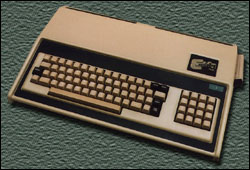
(Philips VG8020), home computer, 64 KB RAM, Z80 system. The
first computer I owned. I learned Z80 assembly on this one and I
still have one (though not my own, which my brother got in 1987).
I remember it took some convincing before my parents bought
one for me :)
 1987: MSX2
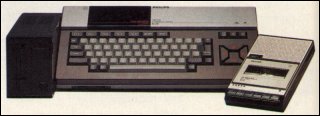
(Philips VG8235/00), home computer, started out with 128 KB RAM. This is
also a Z80 system. I soldered a lot of stuff in this computer: extra
128 KB of memory, extra ROM (an EPROM with a self-written program), a
Z80H so it would run on 7 Mhz and other stuff. Later it was modified
from MSX2 to MSX2+. My MSX2+ was MSX-DOS 2.11 file-compatible and CP/M
compatible. I even used it to write Turbo Pascal programs for the
university. This computer I sold when I desperately needed money.
Stupid me. Sob. I had an FM-PAC, a Music Module with keyboard,
modem, lightpen etc.
1987: MSX2
(Philips VG8235/00), home computer, started out with 128 KB RAM. This is
also a Z80 system. I soldered a lot of stuff in this computer: extra
128 KB of memory, extra ROM (an EPROM with a self-written program), a
Z80H so it would run on 7 Mhz and other stuff. Later it was modified
from MSX2 to MSX2+. My MSX2+ was MSX-DOS 2.11 file-compatible and CP/M
compatible. I even used it to write Turbo Pascal programs for the
university. This computer I sold when I desperately needed money.
Stupid me. Sob. I had an FM-PAC, a Music Module with keyboard,
modem, lightpen etc.
1994: Ahrend
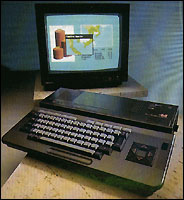
Super PC, a 8088 XT with 8087, CGA, monochrome monitor and only 512 KB
RAM. It had a 20 MB harddisk. This is the system I bought (2nd
hand) a few
months before my graduation, making me not keep my promise of
graduating without PC. I ran UUCP software (Waffle) on this system
to host my domain giga.win.tue.nl and connect to BBSes.
After the harddisk crashed (a few times during my graduation even..)
I sold the floppy drive and coprocessor and the rest of it has
slowly died.
1994: IBM
8150A mini (uniprocessor) with printer (3208-2), tape drive
(8809), 8" floppy, 2 64MB harddisks (8102) and a bunch of
terminals (8775). This filled up one big room and pulled
about 10 Ampere. I had no operating system so I chopped it up into
pieces, sold the parts and threw away the remains (it had been
running DPPX/SP). The only things left are the processor, the
front panel and the looks on people's faces when I tell them
I had an IBM mainframe in the sched :-) I should have made
pictures of the monster.. The terminals came in very handy when
we were having a BBQ: they made great chairs ;-)
Here
is a picture of a complete system elsewhere on the net.
1994:
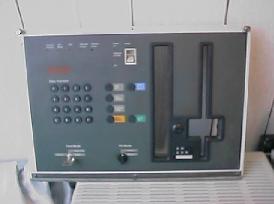
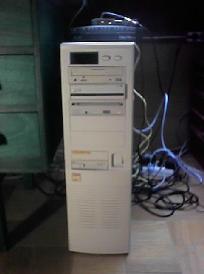
386DX40 with 387, SVGA, 210 MB HD and a 14k4 modem. I bought this
one (2nd hand) when I graduated and installed FreeBSD 1.1.5.1 on
it. It also had a 5 MB DOS partition (yes kids, you could run an
OS on a 5MB -not 5GB- partition). I put in a new motherboard (see
486DX66 item).
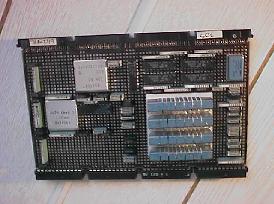
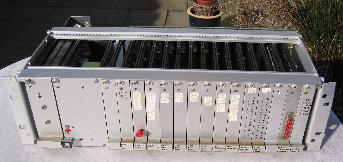
1994: A
professional 2650 system, without keyboard/screen. This system used to
control machines in a factory of Philips Lighting. The system is
called 'Micro Computer Systeem Light (MCSL)'. Its primary use is
real-time I/O but I haven't gotten around to actually doing anything
with it (it not having a screen connected and only taking input from
pre-programmed EPROMs makes this a difficult system to work with).
I threw it away in 2003.
3 1995: 486DX66,
Fast IDE/Fast I/O, Fast SCSI2, Toshiba CDROM player, 210 and 258 MB
IDE HD, 100 and 80 MB SCSI HD, SoundBlaster AWE32, WD8003 Ethernet card
and 14k4 modem. This machine was giga.giga.nl. I started with FreeBSD
1.1.5.1 and upgraded to 2.0, 2.1, 2.1.5, 2.2.1, 2.2.5, 4.4, 4.5,
4-STABLE. End '95 I
put in a 2MB Stealth PCI video card and installed MS-DOS (yes, games..
otherwise I wouldn't be using the Soundblaster you see :) Februari '96
it was time for a CPU upgrade (DX4-100) and some extra RAM (total 16MB).
In May 1996 I bought a 1GB SCSI harddisk for FreeBSD 2.1. I was also
tired of having 5 disks in my machine (for a total of 0.8GB..). With
RAM prices dropping I bought 32MB in October 1996 making the grand
total 40MB. I also bought a single-speed SCSI CDROM player so I
don't have to swap CDs that often :) and swapped the ethernet card
with that of my 386 system (WD8013). Later, after my 1GB disk crashed
I got wise and bought a Tandberg SCSI 1.2GB tape drive to be
able to make backups. To install
my Zyxel Omni TA128 ISDN adapter I also had to install a serial card.
I sold the Zyxel when my wife got a Cisco 765 ISDN router, and
the SoundBlaster when I bought a dedicated games PC in 1998. In 1999
the Ethernet card died (replaced with a PCI card) and I swapped
2 IDE drives for 2 SCSI ones (total 2GB). It then had 1GB + 2GB +
8GB (SCSI). The QIC tape was swapped for a 2GB Exabyte unit and
later a DDS-2 12-tape changer. The 8GB disk died later. When I
started using a cable modem I put in an extra 2GB disk to ease
the transition from FreeBSD 2.2.5 to 4.4, and swapped the 10Mbps
ethernet for 3 100Mbps ethernet cards (external net, internal
net and wireless net). I bought a 40GB disk to
hold my CD collection which I converted to MP3 (lot of work!).
My Audiotron played
these MP3s over the net in the living room (if you have an
Audiotron, use the digital output, as the analog output is of
very poor quality). (The Audiotron was swapped for a Squeezebox 2
and later a Pioneer N-50.)
The CD-ROM player was swapped with a Philips CDD3600 rewriter
on which I make daily incremental backups.
The system was my UUCP server, Samba server, NFS server,
login server, INN server, NTP server, firewall, backup server etc.
for years.
It ran a GRE IP tunnel to tunnel a /28 network and tunnels a /60
IPv6 network. Not bad for a 486 eh? A make buildworld
takes about 24 hours.
End 2002, the thing started crashing at regular intervals. I
suspected a hardware problem. So with pain in my hard, I said
goodbye to my faithful 486 after 7.5 years of duty (24hrs/day)
and bought a Celeron (see 2002 Celeron item) to become the new
giga.giga.nl. Then I found out the crashes were not
hardware-related after all... so this baby is still in excellent
condition (although not my gateway anymore). In 2003, I made
this my second conversion system, with 3.5" HD and
5.25" DD floppies, CDROM and 15GB DLT III XT, running
FreeBSD 5.0.
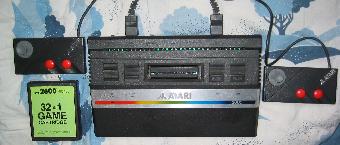
1995: An
Atari 2600 junior games computer. I sold it in 2003.
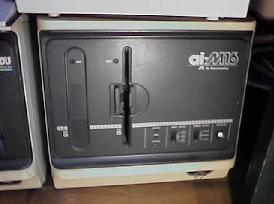
1995: An
ai-M16. This is an old (1983) system from the Japanese firm AI
Electronics. It is a 8086/8087 system that runs ai-KUDOS86 (a
UNIX version). It supports up to 6 terminals and has an 8"
floppy drive plus 2 winchester drives. It was the first UNIX
system at the Rijksuniversiteit Utrecht. It still boots!
Since the terminals were so big I threw them all away except
for one. I gave it a good new home in 2005.
4 1995: A Sun
Sparcstation 1 (a/k/a Sun 4/60), 16MB RAM, 380MB and 100 MB harddisks.
It has been running NetBSD 1.1 and Solaris 2.4 but I switched to SunOS
4.1.4 (which I feel more comfortable with) and later OpenBSD which
struck me as being a great OS. It has been on the net for a year
as www.timewasters.nl (before replacing it with my Sparcbook).
The 380MB disk broke in 2002, so I took out both discs, put in
a 1GB one and reinstalled SunOS 4.1.4 on it.

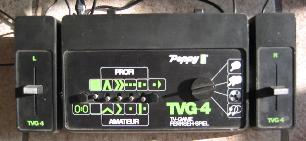
5 1996: A TVG-4
game computer (a clone of the well-known pong game).
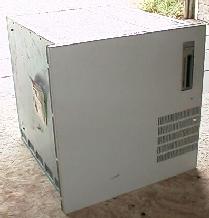
1996: A Sun
3/280, 24MB RAM, an 800MB and a 570MB harddisk, plus an optical disk.
This is phcoms.giga.nl. I gave away the 570MB disk and threw away the
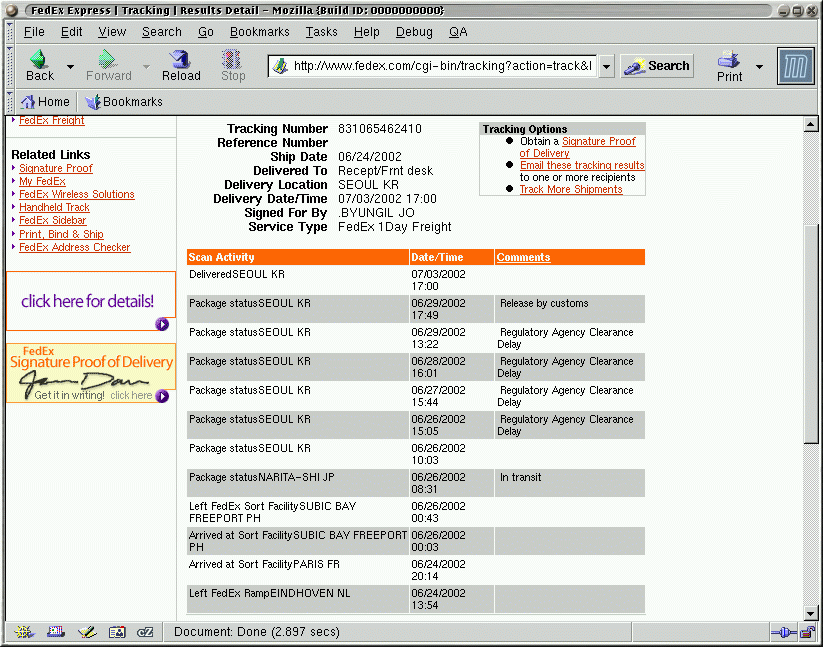
optical disk since I had no media. It ran SunOS 4.1.1 fine until
2002, when I sold the system to a Korean company
who are still using a Sun 3/280 in a production environment and
wanted a spare. Isn't it great to have a 15-year old system
still working?. I used the money to finally buy a NeXTcube.
6 1996: A Sun
3/80, 8MB, diskless with a MG4 framebuffer. I finally was able to
solder batteries to the (dead) NVRAM and get
it working. It boots SunOS 4.1.1 from my FreeBSD machine. In
2018 I started it again, the NVRAM batteries had started leaking
so I had to solder new ones on again and fix the NVRAM. With the
default settings (empty NVRAM) it will not boot and also it will
use the framebuffer as console instead of the serial port.
The internal SCSI did not seem to be working. I installed
SunOS 4.1.1 using a SCSI2SD adapter and upgraded that to
SunOS 4.1.1U1. The disks that were in the system did not seem
to work, until I found out this box needs an external SCSI
terminator! Without it, it will not boot from the internal drive.
I took an old ST1480N 424MB drive and made another installation
of SunOS 4.1.1U1 using the SCSI2SD as installation medium. So
finally, after 22 years, I completed the installation ;-)

1996: A
Telebit Netblazer, which is a system that can hook upto 16 modems to
an Ethernet. Because of the special BIOS and processor which is
soldered on the motherboard, this is of little use. I threw it
away except for the DigiBoard.
1996: A Digital
VAXstation 2000. It only had a 40MB disk so instead of wasting a lot
of time getting a working OS on it, I donated it to somebody else
right away.
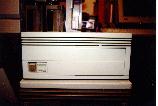
7 1997: 2
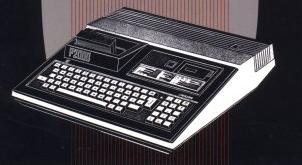
Philips P2000T computers with 48KB RAM (top of the bill) with a lot of
tapes with games and other stuff. I have only 1 left now.
I first used the P2000T in 1982, when I wrote a text-adventure
that didn't fit in the 16KB that particular system had :-)
1997: an
Atari 1040STf (standard thing with SM124 screen). Finally, I can play
MegaRoids! But I'm still looking desperately for an Asteroid
Arcade systems (standalone thing found in Arcade halls). (Update
2005: I bought a real Asteroid Arcade cabinet!) I
sold the Atari in 2003.
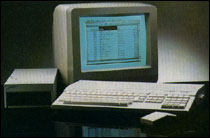
1997: A Sun
3/80, 8MB, diskless, as the one metioned above. I gave it away
in 1999 to make room for new systems.
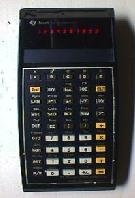
8 1997: A
Texas Instruments TI-58c programmable calculator. Unfortunately,
the memory is broken, bits will flip.
1997: A
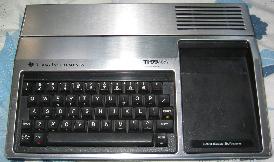
TI99/4A, a 16-bit homecomputer from around 1982. It was the first
computer to impress me with its speech synthesizer (which sounds
terribly outdated these days). I acquired a speech synthesizer in
2001.
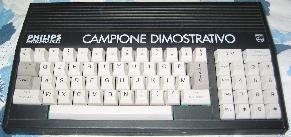
1997: Some
Philips demonstrative system for VideoText, model NMS4000. I
sold it in 2003.
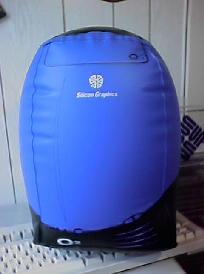
1998: An
inflatable Silicon Graphics O2 system. Mail me for the funny
story with SGI tech support :) (they have a great sense of
humour). In 2003, I got a real O2. I sold the O2 in 2005,
but got a new one in 2017.
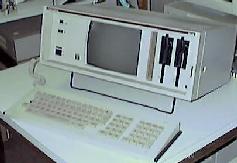
1998: A
Philips P2000C computer. A transportable Z80 system from 1983, based
on the P2000, with 2 5.25" drives (640KB each) and a built-in
9" screen. It has 64KB RAM and runs CP/M. I sold it in
2005.
9 1998: A Sun
ELC (a/k/a Sun 4/25) with 16MB RAM and b/w screen and 600MB of
diskspace. And not just an anonymous ELC, it's the old ELC Wietse
Venema used to work on at the Eindhoven University of Technology. To
honour that fact, it's called wsbs06.giga.nl (it was originally
called wsbs06.bs.win.tue.nl).
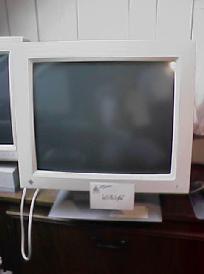
1998: An Apple
Macintosh LC II 8/40 with 14" screen and a Mac LC II 4/80.
I both traded them for other stuff.
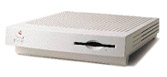
1998: An Apple
Macintosh IIvi 5/80 with A4 monochrome screen. I gave away the
screen. It has 8MB memory, 80MB harddisk and is running MacOS
7.5.1. I am trying to install A/UX, but the A/UX boot floppy
has MacOS 7.1 which won't boot. Later I found out this system
won't run A/UX at all. I traded it for a Mac Quadra 700 in
2004.
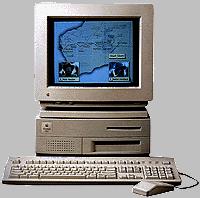
10 1998: Another
P2000T. Never used, still in the original box! :-)
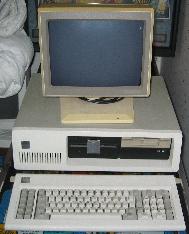
1998: An IBM
PC (512KB, model 5150, the original!). Apart from the original
5.25" drive this system is enhanced with a second drive and a
10MB harddisk. It has the 5151 monochrome monitor. I sold it
in 2003.
11 1998: A
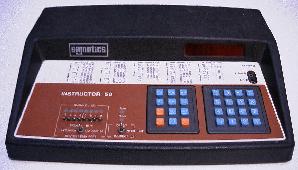
Signetics Instructor 50. This system was designed to teach
working with the 2650 processor. It has 2KB ROM and 640 bytes of
RAM and an 8-digit LED display. It was made in 1978. With this
system, I had my first programming experience in the '70s!
12 1998: A
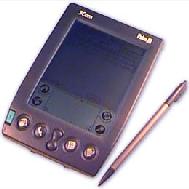
3COM Palm III handheld (19Mhz dragonball, 2MB RAM).
The calibration is not quite alright any more. I have another
Palm III of which the touchscreen doesn't work anymore. That's
why I bought a Sony Clié.
1998: An Atari
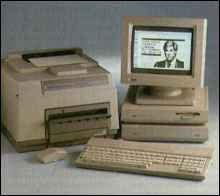
Mega ST 1, with 30MB harddisk, 2nd 3.5" floppy drive and a Mac
and 286 emulator (using extra hardware). I sold it in 2003.
1998: An HP
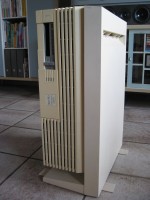
Apollo 9000/433t system with 200MB drive. I put in a bigger disk (1GB)
and installed OpenBSD on it. It has a 1280x1024 20" screen so that
makes a nice workstation. Originally, it was running Domain Aegis
(which is still on the 200MB disk). In 2003, I got a broken
Apollo 9000/425t, from which I took some extra memory, now
this system has 40MB of RAM! The video card is an A1416A
(OpenBSD sees it as 'topcat0'), and it has a token ring card
as well. I sold it in 2005.
1998: An
Apollo 3550, which runs Domain Aegis and has a 600MB drive. I
traded it in 2004.
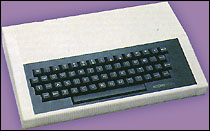
1998: An
Acorn Atom, which I traded for a DAI in 1999 (listed
further below).
13 1998: Yeah!
Finally bought a new computer (well, some parts that together
with some parts I already had form a complete system). It's an
AMD K6-2 360 (running at 380Mhz)
on an Asus P5-A motherboard, 64MB RAM, 4GB disk, Viper 550 (TNT)
videocard, old CDROM/ethernet, DVD player, SoundBlaster Live!, force
feedback steering wheel, SCSI CD-ROM burner (Philips CDD522) and
SCSI CD-rewriter (Philips CDD3600), MPEG-2 decoder card.
This was zoei.giga.nl until my wife got a faster system.
I found out there is exactly 1.5 years between being the fastest
system around, and being the minimum configuration for games.
In 2001, I bought 256MB RAM (only 50 guilders :) and a 100Mbps
network card. In 2001, I bought a Yamaha CDR8424S SCSI CD
rewriter and put the CDD3600 in giga.giga.nl. I also bought
a Miro DC10+ video capture card, and in 2002 a 60GB drive to
store video, which the BIOS doesn't understand. The system
is now my Sun2 bootserver, (my wife has a new system that replaces
'zoei').
1999: A
Sharp MZ800 system with tape and a 2.8" quickdisc. I sold it in
2003.
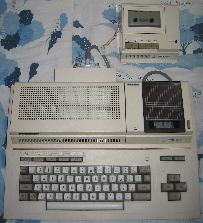
1999: 2
Acorn Electron systems, one with the Plus1 (which I gave away in
1999), and one with both Plus1 and Plus3 (3.5" floppy drive).
I sold it in 2003.
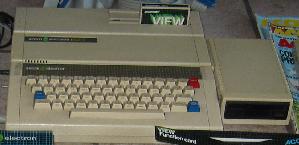
1999:
an HP 9000 model 712/60 system (codename Gecko). 1GB disk,
64MB memory, running HP-UX
10.10. I upgraded it to 10.20, there's no OpenBSD/NetBSD/Linux
support for the PA-RISC architecture. (Note: since 2002, there
is a port of Debian GNU/Linux). I took this system to
the Chaos Communication Camp in Berlin, August 1999. When
my Sparcbook blew up, I replaced it with this system to
host the timewasters.nl stuff. I gave it away in 2005.
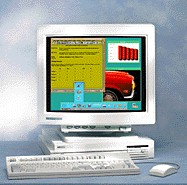
1999:
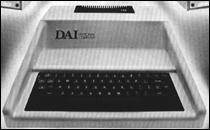
a DAI computer (from around 1983). With stereo sound. And, it
was unused when I got it! This Belgium system became popular
in the Netherlands thanks to a TV course in computing.
I traded it in 2005.
1999:
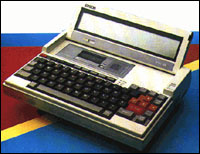
an Epson PX-8 (from 1985). This is a laptop with a 480x64 dots
LCD screen running CP/M. It has 64KB RAM and a built-in micro
cassette recorder and 2 32KB ROM slots. I put in new batteries,
now it's working again. I have brought it to conferences to type
reports. I like the way people look at me ;-) Unfortunately,
it displays only 8 lines of text and vi wants at least 9..
I traded it for an Apple LISA pin in 2004.
1999:
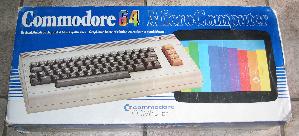
Another Commodore 64 (original version), but this one came with a
1541-II diskdrive. The sound chip was broken, so I put in the
one from my previous C64. I sold this C64 in 2003.
1999:
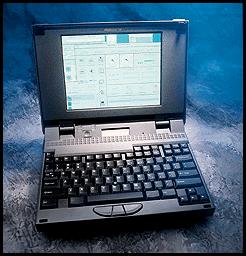
A Tadpole SPARCbook 3 with a dead battery. This is a 50Mhz
SPARC system in notebook format. 810MB disk, 64MB memory.
It has been www.timewasters.nl (running OpenBSD 2.5) for a long
time until a power spike in Amsterdam made the system blow up!!
It is such a shame because this was (at the time of buying)
one monster machine! My HP9000/712 replaced this system as
webserver. It won't work on battery, and the disk is also
physically dead. The system was in the home of late
Bill Squire. Thanks, Bill!
1999:
A micro-VAX II, with 3 disks (2 RA54 and 1 RA51), a TK50 tape,
Ethernet and 12MB of memory. It was running VMS 5.5 but I
installed Ultrix 4.0 on it, because that's what was running on
the first UNIX machine I ever logged on to (the tuerc5.urc.tue.nl).
I took this thing with me to the HAL'2001 hacker conference
where it was running my website (I was impressed with the
performance! Compiling and interactive work was slow but the
webserver did well). A nice side-effect was that the uVAX heated
my tent for me. :-D I traded the system in 2005.
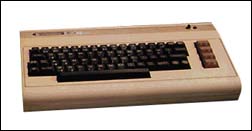
1999:
A Commodore VIC-20. It got its name from the VIC chip that's in
it (Video Interface Chip). It's actually faster than a Commodore
64. I sold it in 2003.
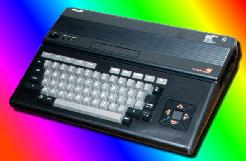
1999:
A Philips VG8245 MSX2 computer.
This system resembles the VG8235 I once had. This
one has a 720KB diskdrive and 128KB RAM standard. My 8235 had
that too, after I built it in :) I traded it for other stuff.
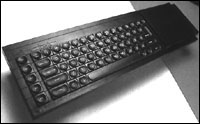
1999:
A Sinclair QL 128 (Quantum Leap), with a stunning 512KB of
memory (the maximum that fits), 2 microdrives and 2 floppy
drives (3.5"). Unfortunately, it is unusable as the keyboard
is non-functional. I gave it away in 2003.
1999:
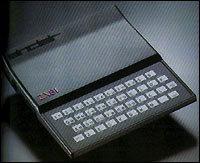
A Timex Sinclair 1000 with a 1016 16KB RAM expansion, which does
not seem to work. It has a seperate keyboard attached to it.
This computer is actually a ZX81 clone, made in the USA with
2KB RAM instead of the ZX81's 1KB. I gave it away in 2003.
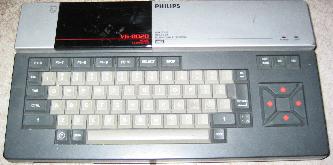
1999:
Another Philips VG8020 MSX system. I sold it in 2003.
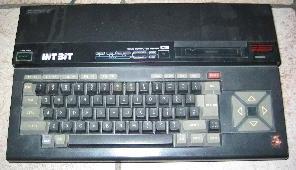
1999:
A Sony HitBit HB-75F MSX1 system. Z80 based, 64KB RAM, 32KB ROM.
I sold it in 2003.
1999:
An HP 9000/425 system. It has 16MB memory and had a 500MB disk
drive with NetBSD, which I took out and put in my VAXsystem
5000/150. I gave it away in 2005.
2000:
An ACT Apricot PC with 256KB memory, 3.5" floppy
drive and 10MB harddisk. This thing has a 8086 processor and
runs MS-DOS 2.11 (but is not PC-compatible). I sold it in 2003.
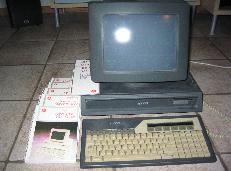
2000:
A DECsystem 5000/150. It has a 50Mhz R4000 processor, and 32MB
memory. I have put in the 500MB drive from my HP9000/425 and
installed NetBSD 1.4.1 onto it. On the back it says it's
upgraded from PM34B-BY to B2-PM439-GA but I don't know what
that means. I traded it in 2004.
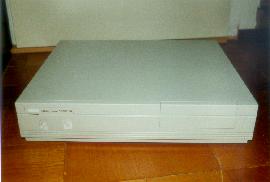
2000:
A Philips P9070 (actually a Motorola 68020 system). It has a
VME bus, with the following Motorola VME cards: 141-2 (CPU),
224-2 (3, memory), 374 (ethernet), 332-2 (2, serial), 332XT
(parallel), 350 (SCSI), 323-2 (ESDI).
I couldn't get this beast to work. I've traded it with somebody
from Finland for an Axil 311 and HP41C. I have found out he has
been able to get this thing to boot.
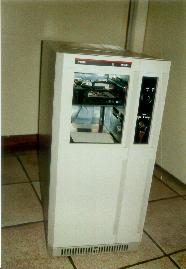
2000:
An Altos Computer Systems (now Acer) 886, originally from 1984.
It has a 80286 processor, 2MB memory, a 5.25" 1.2MB drive, 40MB
harddisk and a QIC tape drive. The system is running Xenix 3.2f
(a UNIX version sold by... Microsoft! In fact, Microsoft was
the first to sell UNIX in Europe after the inventors AT&T).
After 5 years of searching, a kind soul pointed me to an
archive that had the Xenix 3.1a boottapes for Altos.
In 2020, I turned the system on again. The rubber in the tape
drive was gone to bits and a cap on the drive blew when turning
it on. The drive suffered from stiction, but after fixing it
booted into Xenix 3.2f again. The drive sounds like it needs
some lubrication though.
In 2026, it would not do anything anymore. I scrapped it. But
before I did, I read out 5 EPROM's.
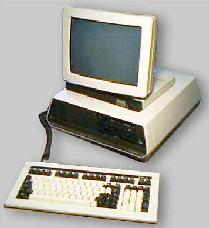
2000:
An Apple IIgs with floppy drive and monochrome monitor. I only
have Appleworks for it. I sold it in 2003.
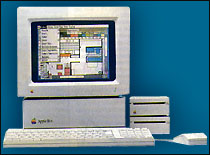
2000:
An IBM 7012 model 30H (a/k/a POWERserver 320H) with 32MB memory and
2 400MB SCSI disks running AIX 3.2.5). Last time I tried, it
wouldn't boot. I got rid of it in 2005.
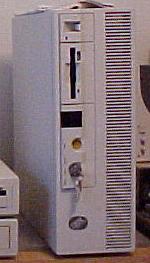
2000:
An IBM RISC System 6000/340 with a broken disk (and a good
disk). I traded it for other stuff in 2002. It looked like
the IBM above.
2000:
A Philips LTP3230 "laptop", with a 12Mhz 80286, 1MB RAM, 40MB
harddisk, an ISA expansion slot and a dead battery. I threw
it away in 2004.
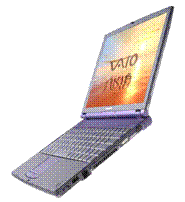
2000:
A Sony Vaio Z600RE laptop. For a few years my fastest system with the worst support you can imagine. In
2010 it was so old, I threw it away.
15 2000:
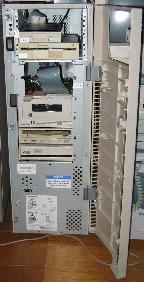
A Compaq Proliant 1000 server. Only the case, but the motherboard
(with a 486DX66) has a lot of goodies on-board: 8MB RAM,
modem, SCSI-2 controller, VGA card. Oh, and there's an
EISA Tokenring card in it as well :-) FreeBSD wouldn't
recognize the on-board SCSI, not even after some hacking. I
got my hands on an old Adaptec 2742T EISA dual-bus SCSI
controller and now FreeBSD is working fine. After installing
an extra 32MB of memory (and 3x32MB extra in 2003), I've made this
into my media conversion system by putting in a 5.25" and
3.5" floppy drive, a CD-ROM drive, a 1GB uncompressed QIC
tape drive and an Exabyte 8mm tape drive. This required some
serious hardware hacking as the Proliant has no standard slots
for drives. I put in a 2GB full-height SCSI disk. This is the
only system I have it fits in. When I turned it on again in 2020,
the 1GB SCSI drive had died. Also there is a memory problem.
I finally found the SCU again (System
Configuration Utility). This needs to write 4 floppies,
which in the end I was able to do on a Windows XP system
booted in command line mode. I also had to solder new batteries
to the timekeeper NVRAM chip. I removed one SIMM. I installed
FreeBSD 4.11 as that version can still be installed from floppy.
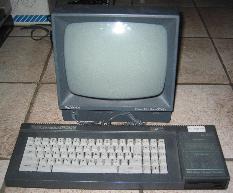
2000:
A Schneider CPC6128 system (German version of the Amstrad
CPC6128) with 3" floppy and 128KB RAM. I sold it in 2003.
2000:
A Philips :YES computer. It has a 80186 processor and flopped
because Philips made it somewhat PC-compatible, not fully.
In 2002 I finally got a keyboard.
This system completes my collection of 80*86 processors :)
In 2003 I got a 30MB harddisk, a mouse (modified MSX mouse),
a compatibility/ISA extension card, a serial cable (not yet
built, and spare PSU and mouse/SASI board. I sold it in 2005.
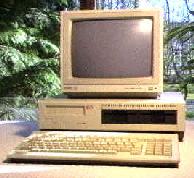
2000:
A Philips VG8245/19N MSX2 computer (French version with
AZERTY keyboard). I traded it for an Atari 600XL.
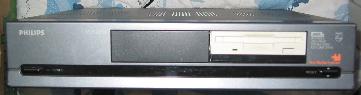
2000:
A Philips NMS8250 MSX2 computer without keyboard.
I sold it in 2003.
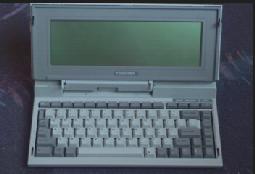
2000:
A Toshiba T1000 laptop (80C88 processor). After soldering in
new chargeable batteries it works again. It has 640KB RAM (512KB
plus 128KB memory expansion) and 640KB ROM (including MS-DOS
2.11), as well as a 3.5" DD floppy drive. The screen is a 80x25
LCD screen. I gave it away in 2005.
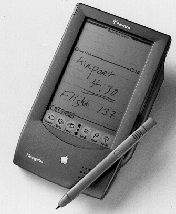
16 2000:
An Apple Newton Messagepad (100?) with a 2MB flash card. It
works but needs a new batterypack.
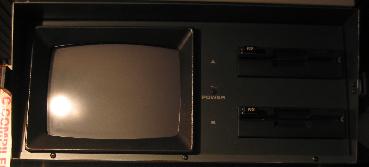
2000:
A Kaypro 4 system running CP/M. It has 64KB RAM and 2 5.25"
drives (394KB each). I traded it in 2006.
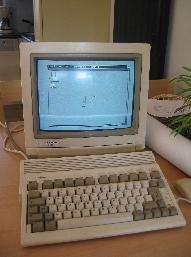
2001:
A Commodore Amiga 600HD system. I sold it in 2003.
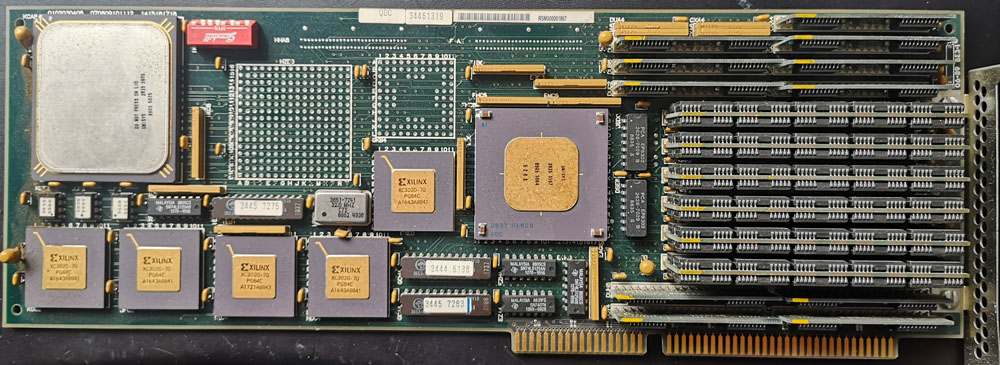
2001:
A Unisys micro-A system running MCP, with 2 external
SCSI drives and an external tape drive. When it boots, it says
it starts running Microsoft Operating System/2 v1.00, after
which it starts up the Unisys CPU board and MCP (and the
80386(?) in it does no more than I/O). I have no clue about MCP
so it's a bit useless now (but fun :). In 2004, I got e-mail
from an David Faultersack, an engineer on the micro-A program,
who mailed:
'The system uses a 2.00" x 2.40" Burroughs processor
module (11 die inside). When running the Burroughs OS, it is
running on the Burroughs processor, with OS2 running I/O
communication.'. Unfortunately, when I tried to boot the
system in 2005, it blew up. I have kept the micro-A ISA
card (which I hope is still working). I cannot boot it though,
as the 386 is needed to load the microcode into the micro-A.
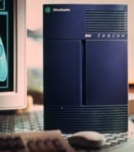
2001:
Two Sillicon Graphics IRIS Indigo systems, with the 64-bit
100Mhz R4000 processor. They do not have graphic boards in them
:-( One has 32MB RAM, the memory from the other one I put into
my Indy. One has about 800MB diskspace, the
other 1.3GB. They ran IRIX 5.3 but I upgraded one of them
to IRIX 6.5.4. I traded one for other stuff in 2003, and
sold the other in 2004.
2001:
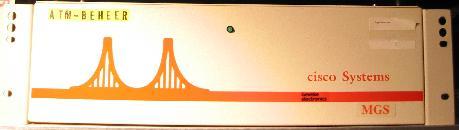
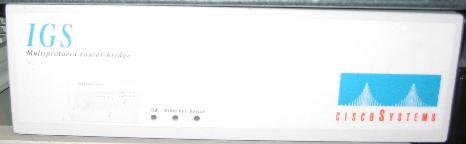
Should I mention Cisco routers here? Maybe I should. I got a
Cisco IGS Multiprotocol bridge/router with one serial and
one Ethernet port running IOS 9.0(3) and a Cisco MGS model
GS/2-2E4S-MC (2 ethernet/4 serial) running IOS 9.1(10), CSC3
processor, 4MB memory. I gave them to Cisco Netherlands in 2005.
In 2019, I learned that Cisco had rebuilt their office and just
threw away these routers! But.. in 2022 I found out they were
not scrapped, but stowed away in storage. I asked to get them
back and they honoured that request!.
In 2026, I found a wonderful new home for them.
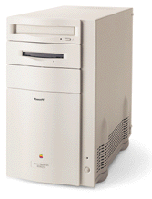
2001:
An Apple Power Macintosh 8500/120 (2.6GB SCSI disk, 64MB RAM,
CD-ROM and floppy drive running MacOS 8.6) with HP ScanJet IIc
scanner with automatic document feeder and a 21" screen.
I'd like to put in more memory, but this system needs very
special DIMMs. I use this system for scanning work. In 2005,
I upgraded the RAM to 224MB (thanks Alex!). I traded it.
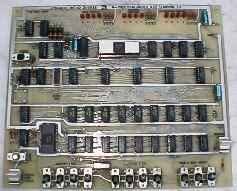
2001:
An AMD Am2900 Evaluation & Learning Kit. This is a kit
(containing a PCB and components such as the Am2901) that, when
built, forms a system to learn microcomputer programming (to be
precise: microprogramming, i.e. programming the microprocessor).
It was made in 1976. You can program single nibbles (it can
store 16 32-bit microwords) and single-step through your
microprograms. Unfortunately, it is not functional, one bit is
broken and some other logic is not functioning as well. Might
be just bad contacts though. Thanks Jan Meijer! I traded it
in 2005. I have scanned the schematics.
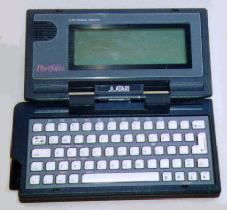
2001:
An Atari Portfolio, with a 80C88 processor, 128KB RAM, 256 KB
ROM. It runs the DIP Operating System 2.11 (an MS-DOS clone).
I still have to fix a key that is stuck. I sold it in 2005.
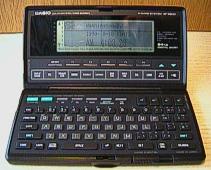
2001:
A Casio SF-9500 '64KB Digital Diary'. This is an electronic
organiser (sold in America as 'B.O.S.S.') from 1990.
It has a slot for 'IC Cards' (I have a scientific calculator
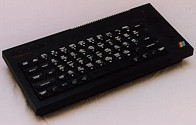
card). I got rid of it in 2005.
2001:
A Sinclair Spectrum+ 128K. This Z80 based system has 128KB of
RAM (hence the name) and 32KB ROM. I no longer have it.
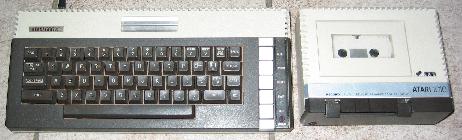
2001:
An Atari 600XL with 16KB RAM and 24KB ROM, with an Atari
1010 data recorder that has 2 broken keys. The 600XL does
not have its original power supply, but I soldered a plug
to connect it to a regular PSU. I sold it in 2003.
2001:
A Philips NMS8255 MSX2 computer with the works: VS0080 monitor,
modem, MuziekModule with keyboard, memory expansion,
and NMS1431 printer. I threw away the printer and sold the
system itself and the keyboard in 2003, the MuziekModule in 2026.
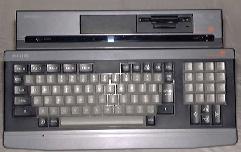
2001:
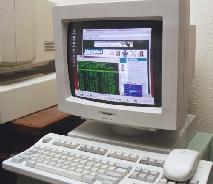
A Tektronix XP114C X-terminal. It boots but I can't seem
to switch from AUI to UTP. Thrown away in 2004.
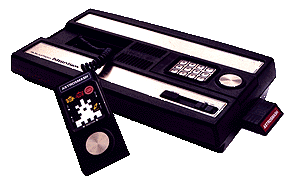
17 2002:
A Mattel Intellivision. A friend of mine had one when
they were introduced (around 1981). It beat all the
competition and I have played many a game on it!
In 2012, I wanted to play a game and found out one controller
is dead.
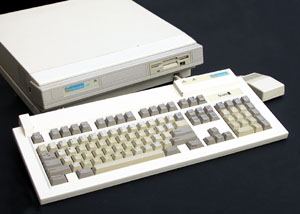
2002:
An Acorn Archimedes 440 running Risc OS 2.00 with a 20MB
harddisk. This system also
impressed me a lot when it was introduced in 1987. It had a graphical
OS and was very fast. It's using the RISC architecture. This
particular Archimedes has a 2-port serial interface card.
I sold it in 2005.
2002:
A Sun Ultra Enterprise 3000. It only had a 501-2749 I/O+Graphics
board (with Sun Creator3D) and PSUs, the rest was stolen from
it. I got a communications board and a CPU board with 2x 250MHz
processors and 256MB memory, but the system still didn't work.
Then I got a replacement I/O board and it still wouldn't work
thanks to a defective PSU. After replacing the PSU the system
finally works.
Meanwhile, I also got disks and diskbrackets so I could put
in 37GB of diskspace (9+9+9+4+4+2GB) and an extra 1GB of memory,
making the total 1.25GB. I've put in a CD-ROM player as well,
which, unfortunately, does not colour with the rest. Special
thanks to Stef and Guido! Great, Solaris 9 now comes with
OpenSSH and IPv6 standard! In 2003, I had the system running
for a week at the MegaBIT hacker conference (it went down
a couple of times because of the heat). Later that year, I
got another broken Enterprise 3000 with some working boards
that I put into mine. It is now fully loaded: 6x 250MHz CPUs,
3GB RAM and 90GB disk (10x9GB). It now also has a CD-ROM drive
in the right color :-) I gave it away in 2011.
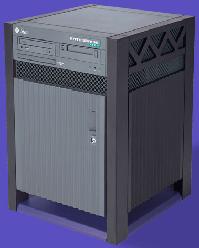
2002:
An IBM PC XT S (model 5160), 640KB RAM, slimline 5.25" floppy
drive, 101-key keyboard, 20MB harddisk and Genoa EGA graphics adapter
(and colour monitor model 5154). This
one was built in 1986. It has an ISA card from microTOOLS with
6 7400-series ICs and 1 unknown IC. I have no clue what it does.
I sold it in 2005.
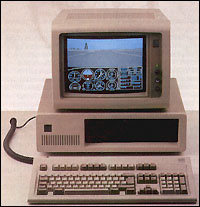
2002:
An IBM PC, model 5150, with cassette interface and 2 full-height
5.25" 360KB floppy drives. (It is not the earliest model, this
one has 256KB memory onboard and 256KB memory on a seperate card.)
I sold it in 2005.
2002:
A Radio Shack TRS-80 model III with all sorts of extra's. No
floppy drives. Comes with the original box, but when I turned
it on it said "POOF" and started smoking :( It's
unrepearable. So, I gave it away.
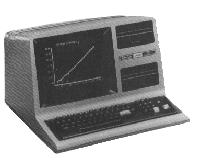
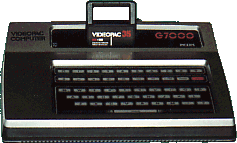
2002:
A Philips Videopac G7000 game computer, model /00 (the
earliest). When I turned it on in 2003, it wouldn't work
anymore.. Turned out to be a loose connector in the PSU.
I gave the system away in 2003.
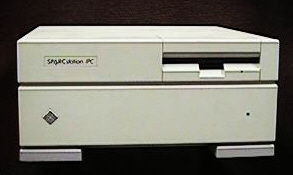
18 2002:
A Sun IPC (a/k/a 4/40) with 24MB RAM, no keyboard, no screen
(but it includes a cgthree video card in addition to the on-board
bwtwo).
After I put in a 500MB disk and fixed the NVRAM
which was dead, I installed Solaris 1.1.2 (SunOS 4.1.4) on it.
2002:
An Apple LC III without keyboard/monitor/mouse. To be installed
later (I don't have a MacOS that will run on an LC III, maybe
I'll install NetBSD). On second though, I sold it in 2003.
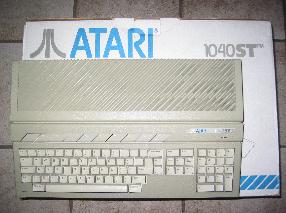
2002:
An Atari 1040STfm with SM125 monitor, in original
boxes. And an SF314 floppy drive. I sold it in 2003.
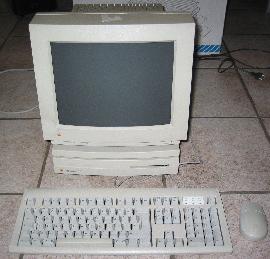
2002:
Another Apple Macintosh LC II, with a color monitor. It has
10MB RAM, a TelePort Platinum modem (28k8) and an Apple
StyleWriter M8000. I sold it in 2003.
2002:
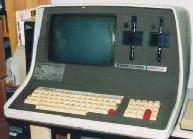
An Intertec SUPERBRAIN QD, a CP/M system with built-in monitor
and 2 5.25" drives. It's not working, some problem with the
PSU, it seems to be unable to hold the high voltage for the
monitor. Since I'm not an electronics freak, I've traded it
for some core memory (a DEC H214 8kx16 board from a PDP-11).
2002:
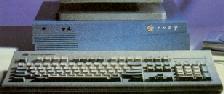
Finally, a Silicon Graphics Indy, with 100Mhz R4600 processor.
It was empty when I got it. I've put in 32MB of memory from one of
my Indigo's and a 1GB disk and installed Irix 6.5.6.
Later I got a 21" screen for it and I bought some RAM,
I put 128MB in the Indy. I traded it in 2003 for an SGI
Challenge S.
2002:
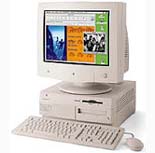
An Apple Power Macintosh 7500/100 (112MB RAM, 1GB disk) with
17" screen and an external SyQuest 88 removable harddrive,
running MacOS 8.6. I traded it for other stuff in 2003.
19 2002:
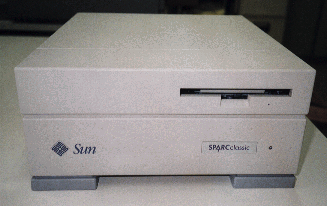
A Sun SparcClassic (a/k/a Sun 4/15) with 32MB memory,
built-in 400MB disk and
external 400MB disk and a neat 15" screen. It ran Solaris 2.4
when I got it, but I put in a 2GB disk and installed Solaris
2.6. There's not enough memory to run Solaris 8.
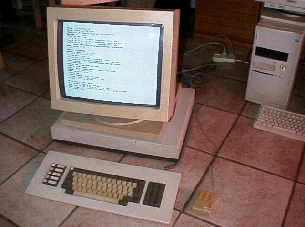
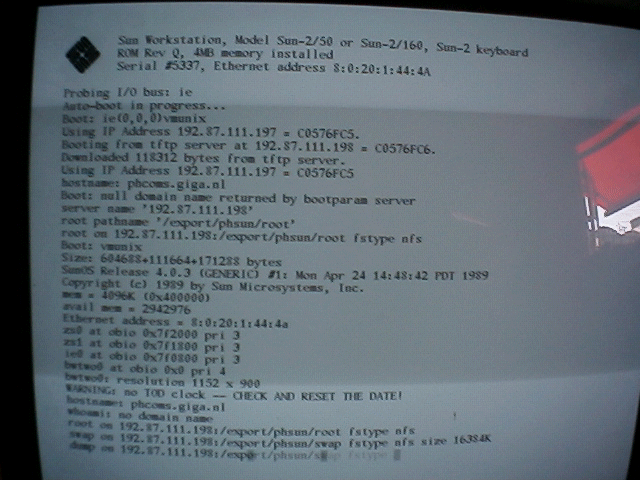
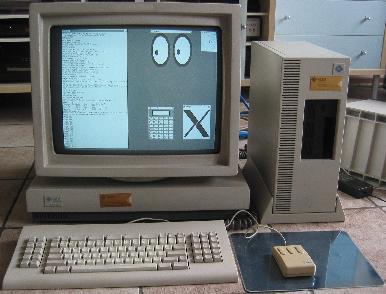
20 2002:
A Sun 2/50-2. It has a memory expansion board, total amount
of memory is a whopping 4MB. Complete with keyboard and mouse.
It only works with a TTL monitor. I installed NetBSD 1.5.2 on
the PC that was previously zoei.giga.nl to get ndbootd working.
It took a lot of work finding
out how to fill the / and /usr directory so the Sun could find
all its stuff. And the /dev directory was a challenge. But,
it worked and the system is now booting
SunOS 4.0.3! I can even run SunView :-) I had this system
online for a whole weekend at the MegaBIT event, August 2002.
I made a copy of the contents of the boot
PROM EEPROMs.
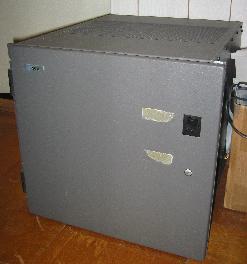
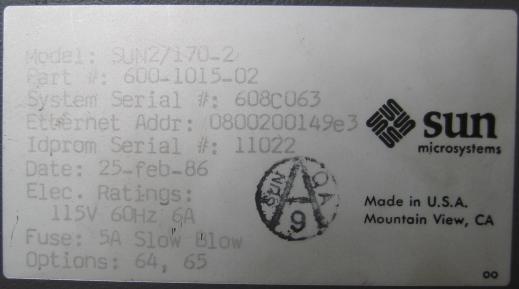
2002:
A Sun 2/170-2. I have these boards:
processor (2x), 1MB memory (14x),
video/kbd/mouse (2x), video terminator, ethernet (2x 3Com, 1x
Sun), SCSI (2x), Xylogics 450 (2x) and a Ciprico tapemaster
board. I cleaned it up and turned it on with some boards. I got
gibberish on SIO-A. It took me considerable time before I found
out it was the processor board. I now get a boot prompt and am
trying to get it to netboot like the 2/50. It does fetch a
kernel which detects the hardware and NFS mounts / and /usr,
after which is panics.. In 2003, I sold this system (but only
because it goes to a Sun lover who is going to put it
online!). I have made a dump of the boot
ROMs which appear to be Rev R, the latest.
2002:
Another Atari 600XL (this one is boxed). I sold it in 2003.
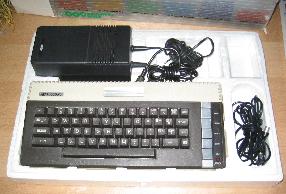
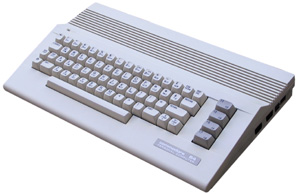
2002:
A Commodore 64c, which is just a regular C64 in a modern
casing. It's the system only, no cables. I gave it away in 2005.
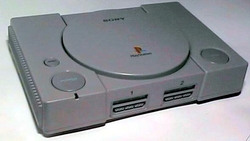
2002:
A Sony PlayStation without controller but with a 1MB Memory Card.
This 32-bit RISC system has a CD-ROM player for its games and
512kb of memory. After I bought a controller and a game I
found out the PSU was broken :-( I bought a new one, put it
in.. nothing! After some fiddling around I found it works
sometimes. Opening the case just a little bit and putting
it on its side helps. I've bought a game (Rollcage) and soldered
in a modchip just for the sake of it. Then all of a sudden
the thing does nothing more than killing fuses :-( So I tossed
it.
2002:
An HP 41C calculator (RPN!). I sold it in 2005.
21 2002:
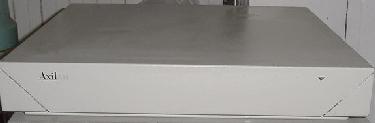
An Axil 311, which is a clone of a SparcStation 10, running
at 40Mhz. With 128MB memory, 1GB disk, cgsix videocard, and
a spare 33Mhz Sparc processor and a spare cgsix card. It
was running SuSE Linux 7.3 when I got it, making it my only
Linux box, but I put in an extra 2GB disk and installed
Solaris 9. I actually used this system on a daily basis
for half a year until replaced with my SGI O2. In 2003, I
swapped the 40MHz processor for a 60MHz one and put in
a TokenRing and SCSI/Ethernet card.
2002:
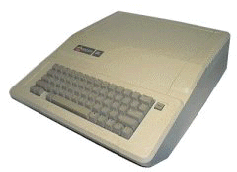
An Apple IIe (model A2S2064) with monchrome monitor and one
floppy drive. I gave it away in 2004.
22 2002:
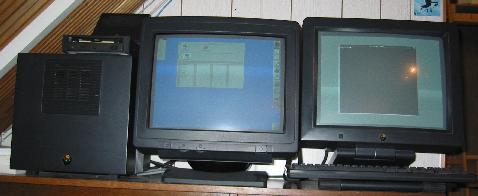
A NeXTcube with both a colour monitor and a black
and white monitor (a Dimension board makes it dual-head),
running OpenSTEP 4.2. It has an original
mouse, keyboard, sound box and CDROM drive. The 68040 processor
runs at 25Mhz and there's 40MB RAM and a 660MB harddisk in it.
What a beautiful system this is.. both hardware and software.
In 2003, I upgraded to a NeXTcube turbo by putting in a new
(33MHz) CPU board. It now has 32MB memory.
In 2020, I lent it to the Home Computer Museum where you can play with it.
23 2002:
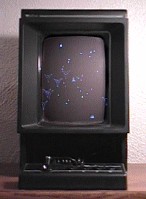
An MB Vectrex with built-in Minesweep game (not as good as a
real Asteroid arcade game -which is still high on my wantlist-
but still very enjoyable). Got me a multicart with almost
all games. Update 2005: got me a real Asteroid cabinet :)
2002:
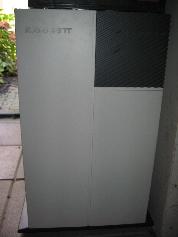
A Sequent Symmetry 2000/200 running DYNIX/ptx
V4.1.3. With all documentation, and loads of tapes including DYNIX/ptx
V2.1.8 and V4.1.3 (which it is running). It has a 1GB disk which
it boots from, a 2GB and 2 650MB disks as well as a QIC tape
drive, 2 ethernet boards and 3 16-port serial boards. This
system normally has 6 80486sx25 processors, this one is missing
one dual-CPU board so it has "only" 4. There's 40MB of
memory in it. On the front, there's status LEDs for CPU
activity, so I wrote a small script 'blinkenlights' which
will turn on and off the CPUs resulting in blinkenlights :)
It's funny to see the jobs being rescheduled between
processors. I found a good new home for it in 2005.
24 2002:
A SparcStation 5, without memory/disk/keyboard. It has ROM
revision '2.15 Pilot' which is interesting.. I bought
256MB of memory (8x32MB) in the hope the system would still be
okay. And.. it is. It has a cg3 card from Integrix which I
swapped with a cgsix from my SparcStation 1. I put in a 2GB
disk on which I installed OpenSTEP 4.2(!). Later I removed
64MB for a trade (192MB left), but I re-bought memory in
2003 so it now has 256MB again. I 2003, I traded it for
another SS5 (170MHz), PROM version 2.29, with an S24 24-bit video
card and 2 2GB disks. I put in a Quad Ethernet card
and installed Solaris 8. This system alway gives weird errors
when 256MB is installed, so I settled for 224MB (removed one
SIMM).

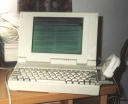
2002:
A Hyundai SUPER-NB386S laptop. It has a 80386sx25 processor
2MB memory, a floppy drive, and a 80MB harddisk. Mine is
black. The BIOS had forgotten all about the harddisk, so I
had to open it up to find out which type it was (Seagate
ST9096A). Opening it up was not easy.. and after closing it,
it now shows bars on the bottom part of the screen :( I threw
it away in 2004.
25 2002:
A Sun SparcStation 2 (a/k/a Sun 4/75). It has 64MB of memory,
an external CDROM drive and a broken 400MB disk. The bwtwo
framebuffer connects to a monochrome 19" monitor, and there's
also a 501-1932 card in it, a token ring card..! The NVRAM
had a dead battery (as to be expected), so I had
to fix that. I also put in a working 500MB disk and installed
Solaris 1.0.1 :-) In 2003, I removed both SBUS cards and put
in a cgtwelve, a 24-bit graphics card (the 'Leo'). In 2018,
the NVRAM batteries had died so I put in a new one.

2002:
Another Sun SparcStation 2! With 40MB, a 200MB disk and
an empty NVRAM, which I fixed. I can't get it to boot however,
it goes through a whole series of tests and stops at 'Mapping
RAM'. It should probe the sbus after that. I can't break to
the boot prompt. Weird. I gave it away.
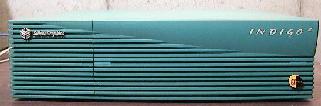
2002:
An SGI Indigo2, R4400/150Mhz. There was no disk in it,
and only 2 SIMMs (it needs SIMMs in pairs of 4). I tried 32MB
from my Indigo and that works.
Although the case has an 'Extreme' label, it does not have an
extreme graphics card but an XL24 graphics card.
In 2003, when wanting to put in 160MB of memory, I found
out the system won't boot anymore? I gave it away in 2004.
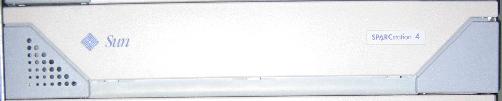
26 2002:
A Sun SparcStation 4 (110Mhz), 1GB disk, 32MB memory, audio
module. I had some memory left from what I bought for my Sparc5,
so I upgraded to the maximum of 160MB. I've installed Solaris 2.6.
Later, I removed 64MB for a trade (96MB left), until 2003 when I
re-bought memory and put in 160MB again.
29 2002:
A Sun SparcStation 10. 60Mhz processor, 2 disks of 1GB each,
cgsix framebuffer. It's running Solaris 8. In 2003, I swapped
the processor with 2 dual-50MHz processors, upgraded memory
from 64MB to 512MB RAM and added a SCSI/100Mbps ethernet
card.

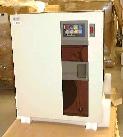
2002:
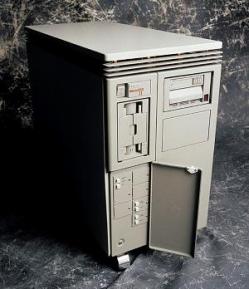
Yes, got me a Sun 3/280 again. This one also has a
Hitachi DK815-10 800MB drive, but only 8MB memory. It also came
with a 1/2" tape drive and SunOS 4.0.3 tapes for 68020.
The boards that are in it: 501-1206 (CPU), 501-1102 (8MB RAM),
501-1155 (Xylogics 472 1/2" tape controller), 501-1166
(Xylogics 451 SMD controller) and 501-1203 (Asynchronous
Line Multiplexer). I connected the old 800MB drive of my
previous Sun 3/280 so it's running SunOS 4.1.1. I haven't
found out how to use the tape drive, it sees an xt0 but
when I try to access rmt8 it says xt0 is offline. The image
below is of the tapedrive. Maybe I'm going to ditch the
tape drive, it's too heavy to get it up to the attic and
space is running out. On second thought, I've
ditched the complete system. I've taken
apart the DK815, keeping the platters as a souvenir. From
the tapedrive, I kept the read/write head and the 6809
CPU. [Note to all hardware lovers: I did try to
give the system a good new home, but nobody wanted it. If I
hadn't rescued it, if would already have been thrown away.
I'd rather not throw away systems, but I have a finite amount
of physical space.]
2002:
Another Sun IPC, 12MB memory, with a bwtwo framebuffer that
appears to be broken. It contains a 50MB harddisk (DEC RZ22)
so it may come as no surprise this system has netbooted.
I increased the harddisk capacity tenfold, then tried to
install SuSE Linux/sparc 7.3, which complained about the
amount of memory and then wanted me to press ALT-F2 (on a
VT320??). Solaris 2.1 also failed miserable (panicked on the
non-disklabeled disk) so I tried NetBSD 1.6, which also barfed
over the limited amount of memory present. So.. I installed
Solaris 1.1.2 and after having found out Solaris 1.1.2 really
wants the disk to be at SCSI id 3, and is really picky about the
speed of the CDROM player used, installation went smoothly
(luckily the 500MB disk was a SUN0535). I gave it away in 2006.
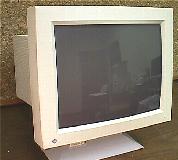
28 2002:
A Sun SLC (a/k/a Sun 4/20) with 16MB memory, no disks. The
screen display has lost almost all of its brightness.
Once again, I had to fix the NVRAM.
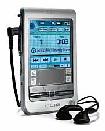
29 2002/2003:
Since my 3COM Palm III died after 4 years, I had to buy
something new. The Palm Tungsten T looks really nice, but I
decided to buy a Sony Clié PEG-T675C which is a bit better
in multimedia. I just hope I don't
need Sony support. With its 66Mhz Dragonball VZ processor
it's almost as fast as my firewall ;-) What disappointed me
is that Sony uses a proprietary audio encoding (ATRAC) on their
proprietary MemoryStick that is only usable on 'special' Memory
Sticks with copyright stuff built-in. Argh. You can also upload
MP3s but the bitrate needs to be at least 128kbps, so even a
128MB Memory Stick is full after uploading one album. After
two weeks, I lost the Clié in the train in Rotterdam.
It was apparantly found by a dishonest person :-((( so I
had to buy a second one.
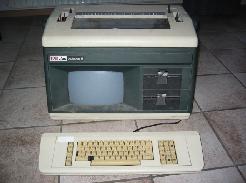
2002:
An AES AlphaPlus 12. This is a system from the Canadian firm
AES with a built-in daisywheel printer. It has 2 5.25" drives
and runs on a Z80A processor. The built-in screen doesn't work,
and the printer is a bit rusty so I gave it away.
30 2002:
When my 80486 system started crashing, I decided to buy
something new. What I wanted was something cheap. A slow
processor is no problem for a gateway system. I like to have
plenty of memory though. A big decision was to move from SCSI
to IDE. I like SCSI more, but it's just too expensive. It
doesn't need to be if everybody started to buy SCSI stuff, but
this isn't going to happen. I also wanted to keep on using my
old CDRW and 4mm drives, that are SCSI (50 pins). You
can't buy old SCSI controllers anymore so I took out the SCSI
controller of the ZOEI system and bought an IDE Plextor CDRW
to put in ZOEI. My new system is a midi tower with an Asus P4B board
that has a Celeron 1.7Ghz CPU (the slowest I could buy..).
Furthermore it has 512MB memory, a cheap TNT2 card and a
80GB IDE disk which replaces the 40GB IDE disk with my MP3
on it (all legal!); the 40GB disk now becomes my system disk,
replacing 3 SCSI disks (2+2+1 GB). On New Years Eve I bought
some batteries for my APC Smart-UPS 600 and soldered a serial cable
so I can get statistics from the UPS. The speed improvement
is very noticable. The 486 couldn't fill the 100Mbps line when
using encryption (scp). Also, programs like mutt and slrn are
noticably faster. In 2004, I bought a 200GB disk and upgraded
to FreeBSD 5.3 (from 4.10) so it now has 80+200GB disks. In
2005, I swapped the 80GB with another 200GB disk for the MP3s,
since I started ripping WAVs from my DTS CDs to play on the
Squeezebox2 that has replaced my Audiotron. I upgraded to
FreeBSD 5.4 at the same time. Somewhat later, I bought a
2.4GHz Celeron (more power, less power consumption). It is
now running FreeBSD 6-CURRENT. In 2007, I made this system
a backup server and bought a new 'main server' (see
2007 mobile sempron item).
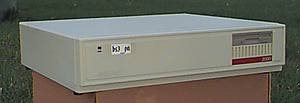
2003:
An Intergraph InterPro 2020. This things runs CLIX 3.1 r.7.5.17
(CLIpper uniX?), which is a UNIX clone on a Clipper C300
processor. Too bad there's no keyboard/screen because this is a
graphical workstation/server (it has 'MMG' graphics). I can
however access it via the serial port. It has 16MB memory and a
400MB harddisk. I know the root password but the serial console
is marked as insecure and won't let root login directly, so
I had to hack it (I put the drive into a second system, used
dd to transfer all contents, looked for the password file and fed
it to a password cracker - backup plan was to edit the password
file in the image and transfer the image back to the disk).
I sold it in 2005 to somebody who already had an Intergraph.
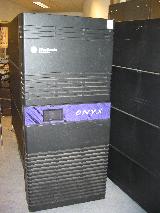
2003:
An SGI Onyx. This is a huge beast! It is not a fat machine
though: 64MB memory, 1GB disk, 4x 100MHz R4400 processors. But,
the casing is complete (Onyx cases are rare) and it has two
RealityEngineII pipes, both with Multi-Channel Option board.
It's running IRIX 6.5.10 at the moment. The downside is its size,
the amount of noise it makes and the fact that it needs 3-phase
power. You can take a look at some pictures
and the boot messages and hinv output.
Because of the aforementioned downsides, I sold the system in
2003.
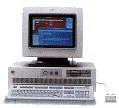
2003:
An IBM RT (IBM 6151 model 115) with monitor and keyboard.
This is IBM's first RISC system (before RS/6000). I was able
to boot it (it ran AIX v2.2.1), but I didn't know any userid's or
passwords. I was able to boot from a maintenance floppy and
edit the password file on the 70MB ESDI disk. After that,
I could log in but found that several files in /etc had
become corrupted. So I re-installed AIX (version 2.1.1)
from floppy. This was quite a hassle since the disk drive
would occasionally not work. The system has an ethernet
card (TCP/IP not installed yet) and has 1762KB of memory if I may
believe the output of 'dd if=/dev/mem of=/dev/null bs=1024'.
I traded it in 2004.
31 2003:
A Sun SPARC Xterminal-1, 32MB memory. The Xterminal-1 is just
a SparcStation 4 that does a netboot (but has less room
for DIMMs).

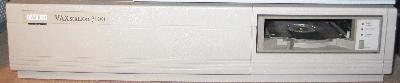
2003:
A VAXstation 3100 model VS42A-DS with TZ30 tape drive, 100MB
harddisk, 16MB memory. I can't seem to boot VMS from tape.
Ultrix install also doesn't work smoothly from tape. I
temporarily hooked up a CD-ROM drive and installed Ultrix
4.4. Thanks Kees for the console cable!
In 2026, I wanted to check the system and had lost the console
cable. I gave the system away to Kees (after checking it
still booted Ultrix!) in exchange for a TZ30 drive, so I can
still read TK tapes if need be.
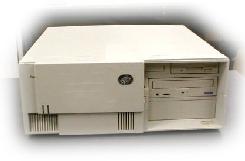
2003:
An IBM PowerPC model 7248-133 (133MHz), with two PCI cards
(a Lanstreamer and a POWER GXT150P graphics card). Somebody
however had removed memory, CD-ROM, harddisk, floppy drive
and cut the wires supplying power to the drives! I had to
solder new wires on as the PSU is not a standard PC PSU.
I also put in a 2GB SCSI disk, a SCSI CD-ROM player, a
floppy drive and 32MB of memory and was able to install
AIX 4.1.3 on it. I sold it in 2005.
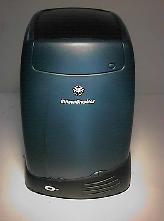
2003:
A (real) Silicon Graphics O2 with monitor and keyboard. It
has a 180MHz R5000 processor, 128MB memory, 2GB disk and
CD-ROM player. It also has a Fore PCA-200E ATM interface.
It was running IRIX 6.5.3, I've upgraded to 6.5.15. I used
this system at work as a workstation for quite a while. Later
I added an O2 camera. I sold it in 2005.
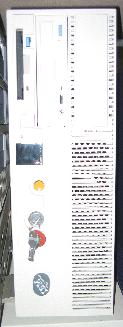
2003:
An IBM RS/6000 7012 model 390 with 128MB memory. It came
with an IBM 7131 Storage Subsystem (model 405) with 5 4.5GB
disks. I don't have an SSA cable though. The system itself
also has 4.5GB drives, two of them. I installed AIX 5.1L but
somehow, I couldn't login on the console (when I entered a username,
it just comes back with 'login:'). I finally figured out all
serial cables I tried didn't support DSR/DTR.. Now it boots
AIX 5.1 and meanwhile I was able to get my hands on some SSA
cables. It took a long time figuring out how to be able to
use all the diskspace with all those volume groups, logical
volumes and filesystems. I sold it in 2005.
33 2003:
A Sun 386i/250 (codename RoadRunner) system, with color
frame buffer and VGA/EGA option board, 16MB, 327MB harddisk
and 19" color monitor (this is about the maximum configuration).
SunOS needs to be re-installed. This system has a 80386DX25
processor and a numeric co-processor. It can run some DOS programs.
I am currently having problems installing SunOS, it boots the
kernel from the first floppy, but gets stuck on loading the
memory disk from the second floppy. After months, a kind soul
sent me a disk image of a similar Sun386i, and after
transferring it to my disk, it works! (SunOS 4.0.2) However,
the network didn't, and I found out this was due to the NVRAM
battery. In fact, the empty battery had been causing all
installation problems! I didn't notice as the Host ID and
ethernet address were not 0xffffff, ff:ff:ff:ff:ff:ff as all
other Suns with empty NVRAMs have, but still had their original
values. The values must be stored elsewhere.
After soldering in a new battery, I could install a clean
SunOS 4.0.1 with all additional software clusters. Then, there was not
enough diskspace left to upgrade to 4.0.2 so it's still running
4.0.1. See also http://www.sunhelp.org/386i/.
2003:
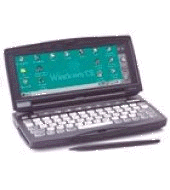
An HP 620LX handheld running Windows CE 2.0 in 16MB of RAM.
Unfortunately, I need a newer version of CE to be able to
run NetBSD. And Windows CE is in ROM, only upgradable by putting
in new hardware. I sold it in 2005.
34 2003:
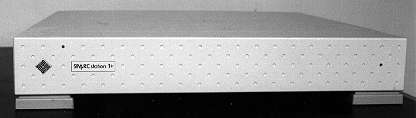
A Sun SparcStation 1+ (a/k/a 4/65). It has a cg3 and 64MB of RAM.
I put in the 200MB disk from my broken SS2 which happened to
have Solaris 2.5 on it. Great, now I am only missing the IPX in
the sun4c range, and I'm doing pretty well in the sun4m range as
well.
2003:
An IBM 7012 model 360 with 128MB memory, 3GB disk (1+2GB). An
old installation of AIX 4.?.? was still on the harddisk, but
I didn't have the password and the console was marked insecure.
I wasn't able to install AIX from an external CDROM player, so
I took out the disk, put it in another system and found the
encrypted root password. The passwords were very good, which is
why it took >11 CPU days to crack the root password. I gave
the system away in 2005.
2003:
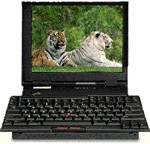
An IBM ThinkPad 701CS laptop, the famous 'butterfly' model
with folding keypad. It has a 80486DX4 processor, 16MB memory
and a 500MB harddisk running Windows 98. I have a second
500MB harddisk on which I planned to install FreeBSD. Problem
is that the PCMCIA controller is not supported so I can't boot
over the network, and I don't have a CD-ROM player. I sold
it in 2005.
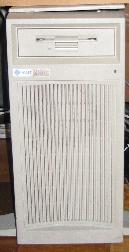
35 2003:
A Sun SparcStation 20. It has a SuperSPARCII processor at
75MHz, 192MB memory, a 2GB disk, floppy and CDROM and a cgsix
framebuffer. I installed NetBSD 1.6 (first SPARC CD I found
:). The system is flakey.. seems like it is the memory, although
test-memory won't show any problems (got selftest-#megs right).
Sometimes the POST even complaints about a DSIMM.. Later, I
traded it for another SS20 which has problems with the on-board
graphics (I added a 24-bit graphics card) but has 4 50MHz
CPUs, 320MB RAM, 2 1GB disks and a CDROM player. I've
installed Solaris 9. In 2004, it finally dawned on my that the
on-board video only works with a VSIMM, so I put an 8MB VSIMM
in. It now has 288MB RAM. In 2005, I replaced the CPUs with
2 125Mhz HyperSPARC CPUs and also added GigaBit ethernet,
a dual parallel card and a video capture card.
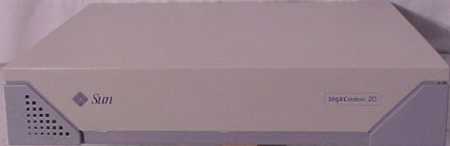
2003:
An HP 9000 model 712/80 (codename King Gecko). 1GB disk, 92MB
memory. It has HP-UX 9.05 installed. After booting in single-user
mode I was able to change the root password. I sold the system
in 2005.
2003:
A Sun SparcStation IPX, with an empty NVRAM. After
fixing, it turned out to have a 0.5GB disk
with NetBSD 1.3.3 on it, and 52MB of memory (weird amount!).
The videocard is a cgsix. I traded it in 2003.
2003:
Another SparcStation IPX, this one being the old scot.nluug.nl,
an important machine in the history of the Dutch UNIX Users
Group. It's NVRAM is still working and there's 24MB memory,
a 420MB harddisk and a cgsix framebuffer inside. It's currently
running SunOS 4.1.3U1. It has a color monitor. I upgraded the
memory to 64MB. I gave it away in 2006.
2003:
Another Silicon Graphics Indy, with 100Mhz R4600 processor,
64MB memory, 0.5GB disk running Irix 5.3. It came with a
big screen. I traded it for a Philips CDI210/20 CD-i player
(which runs CD-RTOS, derived from OS9, I was able to run
a shell on it :-).
2003:
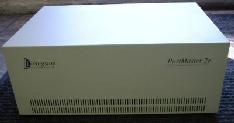
Not exactly a computer: a Livingston PortMaster 2e with 30
serials. It was recovered after a fire and it still smells a
bit. I had to paint the cover. It still works, it runs
ComOS 3.7.2 and it has 1MB memory. I threw it away in 2005.
2003:
A DECserver 200/MC. This is an 8-port terminal server. It uses
old DEC protocols like MOP boot protocol and LAT. I was able to
get all this running on my FreeBSD box. I threw it away in 2005.
2003:
Another SGI Indigo2. It has a 150MHz R4400 processor, 1GB
bootdisk with IRIX 6.2, a CDROM player, 64MB of memory and
GU1-extreme graphics. I traded it for other stuff in 2004.
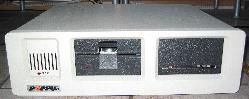
2003:
A Durango Poppy II system (80286-based) with 640KB memory,
71MB MFM harddrive and 5.25" QD (Quad Density, 720kB at 96tpi)
floppy drive. It won't boot from harddisk, and the floppies
(Xenix 3.1f Upgrade+) that came with it have too many errors.
I got Xenix286 as 360KB images, but the system won't boot
from these (not even with a DD drive).. So I probably need
a special Xenix? Sometime later, the boot floppy _did_ run
(maybe the heat helps?). However, the installation scripts
(and my manual fsck/mkfs commands) all stopped with errors
on the MFM drive. I tried another drive but got the same errors,
maybe the controller is broken. I threw away (most of) the system
in 2004.
36 2003:
A Sun SparcStation LX (a/k/a Sun 4/30), 72MB memory, 1GB disk,
cgsix framebuffer running NetBSD 1.6.
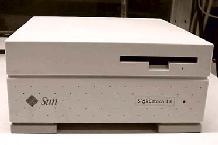
2003:
A NeXTstation Color Turbo (a 'slab'). A 68040 system with 32MB memory,
424MB internal disc and colour monitor, running NeXTstep
3.3. It has an ADB keyboard/mouse. Unfortunately, the word
'Color' on the cover has disappeared. I sold it in 2005.
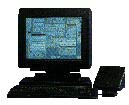
2003:
A NeXTcube Turbo, 32MB memory, with monochrome display
and an external Contemporary Cybernetics CY-2000 650MB MO drive
(the only MO disk I have doesn't seem to work). Both internal
drives (1 and 2GB) had many errors so I threw them away. Also,
I put the turbo CPU board in my other cube and this one now has
a 25MHz CPU board with 40MB memory. I had many difficulties
installing OpenSTEP on a new harddisc, I finally gave up and
made a bitwise copy of the 424MB drive in the NeXTstation (I
happened to have a spare drive of exactly the same size) and
put that in the cube. It works :-) In 2005 I was able to install
OPENSTEP 4.2. I sold it in 2005.
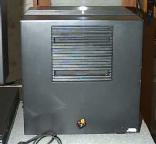
2003:
A DEC 3000/600. My first system with Alpha CPU. (21064 @175MHz).
Inside are 64MB memory, a 1GB disk and a CDROM player. Also,
this system came with a huge 21" monitor, the VRC21-HA.
The harddisk was emtpy and I installed Tru64 4.0D on it.
I sold it in 2005.
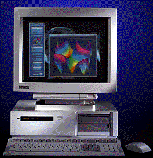
2003:
SGI Indy R4600, 133MHz, 256MB memory, with IRIX 5.3 installed.
This one has an IndyCam :-) It has a 2GB and a flakey 4GB
harddisk. I no longer have it.
2003:
Digital Personal Workstation 200i2. This is a dual Pentium
Pro system (200MHz). It has 256MB RAM. I installed 4 and 6GB
IDE drives and it now runs FreeBSD. I sold it in 2006.
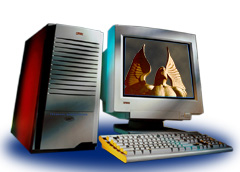
2003:
A Digital VAXstation 2000 with 6MB memory, expansion unit
and broken handle. I had to solder a console cable. It doesn't
boot from disk and I don't have a TKZ50 drive, so netbooting
was my only option. After a lot of small problems I was able
to boot an OpenBSD ramdisk kernel, which did not probe the RD54
disk. Reformatting the drive (TEST 70) worked however.
After a long time, I found out OpenBSD just doesn't support
the controller. I then tried NetBSD 1.6.1 which states it does.
It wouldn't boot however so I had to use the NetBSD 1.5.3
bootloader. This still didn't work. I finally tried NetBSD
1.3.2 which does support the controller. I'm disappointed
that NetBSD documentation is not correct and the VS2000 is
not supported any more. Anyway, after a lot of work I finally
got NetBSD 1.3.2 running, but the installation manual for it
was incomplete. I was however able to label the disk correctly
and install all the necessary stuff. I traded it in 2004.
37 2003:
A Sun 3/60 with 4MB memory (and one for spare parts). I put
in some extra RAM, it now has 24MB (the maximum). I wanted to
get it to netboot SunOS 3.5. It does load the kernel and mounts
the root disk via NFS, but it then wants to do network disk
mounts. I have no server program that will facilitate this
(ndbootd only implements the boot stage), so I decided upon
SunOS 4.0.3, with a 4.1.1 kernel (don't ask). However, after
the device probing the system hangs after doing getattr's on
the swap. After a lot of debugging I found out the boards in
the 'good' and the 'spare parts' systems had somehow been
swapped, I had been spending hours on a defective 3/60 :(
After I found that out, it was easy to install SunOS 4.1 from
the original tapes :) onto an external 1GB disk. I then built
the disk into the 3/60 and it works like a charm.
In 2005, I added a colour card (cg4) from another 3/60.
In 2018, I started up the system and after 5 minutes, a
capacitor blew. I soldered in a new one and it is again fine
I also replaced the cg4 with a cg6 (that has a 13W3 connector,
which is easier for me than the RGB connectors of the cg4).

2003:
An HP 3000/922LX with some extra hardware (printer, 2x DTC
(terminal server), terminals, HP OpenView management station).
It has 4 disks (670MB each, HPC2203A) and a DDS-1 tapedrive
(HPC1501A). I ditched the OpenView machine (a Vectra QS/16S),
the DTCs and the printer. The (uniprocessor) system has 32MB
memory and boots MPE/iX. A problem was logging in. I couldn't
find any single-user mode boot, but was able to get the
password from one of the backup tapes :) The system boots,
but MPE/iX is new to me. Also, one of the 4 disks doesn't
work so not all files are available, or better: almost no
file is available. Especially the POSIX files. I haven't
found out how to boot from tape, choosing the alternate
boot path didn't work. I gave it away in 2004.
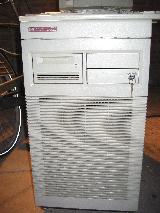
2003:
An NCR Tower 32/200 (the label says "Class 3800-MSTD, Model
0100"). This is a really nice system, nicely built. It has
a QIC tapedrive, a 104MB harddisk, 4MB memory and is running
System V.3. The 68020 processor is cooled by a bag of gel.. :)
I gave it away in 2005.
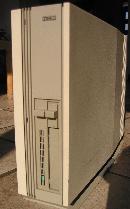
2003:
An SGI IRIS 4D/310. It's upgraded, it has an IP17 (Crimson)
CPU board (100MHz R4000). It came with 64MB of memory and a 1GB
disk. It runs IRIX 5.3 and has a Reality Engine board. After
building a cable to connect an old SGI keyboard (the IRIS has a 15
pin connector), it didn't turn out to work. The mouse does, but
the keyboard doesn't.. I traded this system for an R5K Indy.
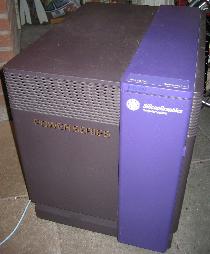
38 2003:
A Sun SPARCstation Voyager with 80MB RAM, 810MB drive and
a bwtwo (rarer than the cg6 version?). No battery, but with
a compact keyboard, mouse and carrying case. It runs Solaris 2.6.
I found the SunLink ISDN
somewhere on the web. The NVRAM battery has died.
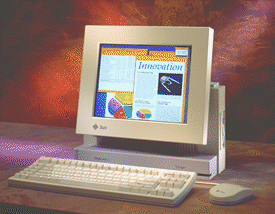
2003:
Another Indy, but this time a R5000 (150MHz). 64MB RAM, 2GB disk,
IRIX 6.5.21 installed.
2003:
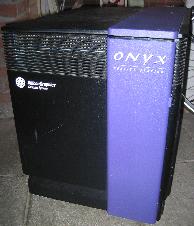
An SGI Onyx Reality Station. It has a 200MHz R4400 (IP19), 64MB
RAM and a 2GB disk with IRIX 6.5.16. And of course a Reality
Engine 2. At first, all I got on the monitor was a red mouse
pointer, nothing else. After taking out all the boards and
re-seating them, it worked again. I re-installed IRIX 6.5.20
onto it. Since I couldn't get a CD-ROM player to work (I used
the 68pin SCSI connector on the front, connected to the IO4
board, but I didn't get it to work), I decided on a network
install. Since the CDs are in IRIX format, I needed an SGI
for this, I used my O2 for it. After a lot of CD swapping,
IRIX 6.5.20 is now working fine, but I traded the system
for other stuff in 2004. With pain in my heart, but now I
have a NeWS system.
2003:
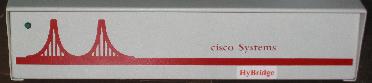
A Cisco 'HyBridge' router (serial+ethernet), model
CHYB/2-C-ES-MC. It runs IOS 8.3(1). I gave it to Cisco
Netherlands in 2005.
39 2003:
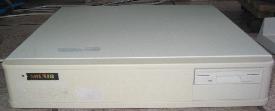
A Solair DTKstation/Classic+. This is a Sparc clone (50MHz
microSPARC processor). It has a 1GB disk and 32 memory. I
installed OpenBSD 3.1 on it. I also have one for trade
(with 16MB memory).
40 2003:
A Solair DTKstation5/5Sparc2. This is a SparcStation 5 clone (85MHz)
It has a 2GB disk and 64MB memory. I installed OpenBSD 3.1 on it.
41 2003:
A Sun 3/50 with 8MB Helios memory expansion (total 12MB) and a Sun
511 "shoebox" with a Wangtek 5099 QIC-24 tape unit and
a Toshiba MK156 (141MB) drive, including a stand. I've put in a
68881 coprocessor. The drive wouldn't spin up, I had to open
it(!) and help it, and even then, I now have to rapidly turn
the drive when powering on to get it to spin up. The tape drive
is also problematic. I cleaned the head and got the belt moving
again, but the drive isn't able to turn the reel any more.
The system won't boot from any SCSI device :( (SCSI probably
broken) but netbooting works.

2003:
Another Sun 3/50 with 4MB Helios memory expansion. This one also
has a Sun 511 "shoebox" enclosure with stand, holding
a Micropolis 1558 (327MB) drive. This Sun 3/50 is older than the
previous one, as this has a sun2 casing (with metal pin on
top to hook up the monitor which is included). I've put in 4 more
megabytes of RAM (total 12MB) and a 68881 coprocessor. The drive
had some problems with the power connector which had gone loose,
and it also suffered from some stiction (the drive has
apparantly been sitting idle for over 8 years - WARNING: clock
gained 3148 days!).
I also had some trouble finding out the 3/50 does only boot from
the disk with SCSI id 0.. I've installed NetBSD 1.6.1 on it
(compiling a kernel takes 14 hours and 40 minutes). What's
bad about this system is that the kernel has a maximum size
of 1MB-16kB because a larger kernel would overwrite the video
memory.. My first kernel was way too big. The second one was
1033422 bytes (1230 bytes too big..). The third one worked,
with this kernel configuration (well
actually I also added IPv6 support, but the lance ethernet
does not support multicast :-/ ).
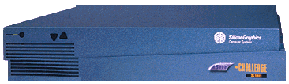
2003:
An SGI Challenge S R5000 with 128MB memory and 1GB disk.
I traded it in 2004.
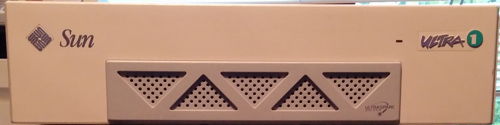
42 2003:
A Sun Ultra 1 (model 140), 143MHz UltraSPARC, 512MB memory,
9GB disk, a DDS2 tape unit (Archive Python) and two additional
SCSI/100Mbps ethernet cards. I had to upgrade the OBP to be
able to run a 64-bit version of Solaris 9, which it now
does.
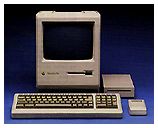
2003:
An Apple Macintosh Plus with original System 5 floppies and
carrying case. I traded it in 2004.
43 2003:
A Tadpole SPARCbook 3. This one still works. It has 32MB memory
but I put in the 64MB from my broken SPARCbook. This one has
a 1.2GB drive on which I installed OpenBSD. The 810MB harddisk
from my other SPARCbook appeared to be physically broken, so
I ebayed some more 810MB drives and installed Solaris 2.5.1 on
one of them.
I've made a copy of the
two EPROMs, that
includes the OBP.
2003:
MIPS RC3330. It has 64MB memory, a 1.2GB disk and an Archive Viper
150 tape drive. The disk is broken so I put in a new one and
installed RISC/os 4.52 from tape. This would only work after
I had reprogrammed the NVRAM chip using a Sun IPX, following
the instructions from the NetBSD/mipsco FAQ. It now works. The
processor is an R3000A at 33MHz (with R3010A). I traded it in
2006 with the other MIPS for an RDI Britelite.
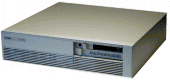
2003:
MIPS 3000 Magnum (a/k/a RC3230). It has an R3000A at 33MHz
(with R3010A), 32MB of RAM, a 500MB harddisk and an Archive
Viper 150 tape drive. This system also had a broken drive
(replaced with a 1GB drive) and an empty NVRAM. I installed
RISC/os 4.52. This system also has a Specialix ISA multiport
I/O card. I traded it in 2006.
2003:
HP 700/RX Xterminal. It has 4MB RAM. I threw it away in 2004.
44 2004:
A Sun JavaStation-NC, the 'Krups' model. It has a 32MB SIMM and
also an 8MB Flash SIMM containing JavaOS (but I don't know any valid
login/password combination). It netboots NetBSD but I don't know
how to read the flash from NetBSD...
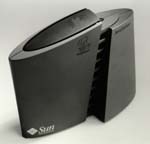
2004:
A MicroVAX 3400 with a TK70 tapedrive and two RF71 (400MB DSSI)
harddrives. It has 20MB memory. It ran VMS 5.5 but I had to wipe
the drives. I tried installing VMS 5.5 but my tapes wouldn't
work so I installed Ultrix 4.0 (hey, I'm a UNIX man ;-). I
traded it in 2004.
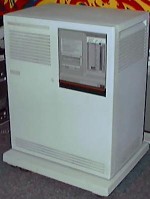
2004:
A MicroVAX 4000-200 in a BA440 enclusure. It contains an Emulex
UC08 SCSI controller, async mux, comms controller, 16MB RAM,
2x 380MB DSSI drives and a TK70 tapedrive. The tape drive isn't
able to turn the tape any more (involving me rescuing a few tapes
from the drive). Putting in the TK70 from the other VAX didn't
work either. Netbooting also wasn't very succesful. I get
an error after the bootloader is loaded via MOP. I gave it
away in 2004.
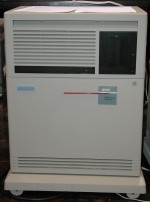
2004:
An HP9000/715-100XC with 224MB RAM and a 2GB harddisk. I
have to find an HP SMD10 box to be able to connect an HP-HIL
keyboard. I traded it in 2004.
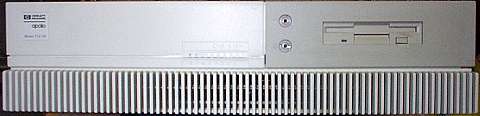
2004:
An HP Visualise B180L with a DDS2 tapedrive (picture shows
one without) and an extra Visualise FX4 3D Graphics card.
It has 256MB memory and a 9GB disk, it runs HP-UX 10.20. I sold
it in 2005.
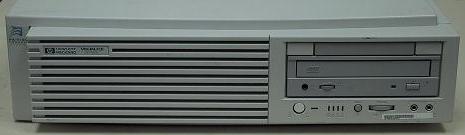
2004:
An IBM ThinkPad 300 laptop. Built-in floppy drive, 80MB
diskdrive. This thing has a 10" monochrome LCD screen,
a 80386 processor @25MHz and 4MB memory. It's running Windows 3.11
for Workgroups and has its original IBM bag. I traded it in
2004.
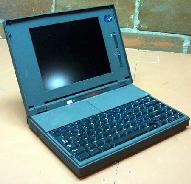
2004:
A Sony NeWS NWS-1850. 16MB RAM, QIC tape drive,
an NWB-225A videocard and an NWB-240A card (printerdriver?).
This system has 2 68030 processors. To be installed, I have
created boottapes from images, and found out it will only
install on a harddisk it knows. I then used a binary editor
to hack the kernel and boot scripts so it recognises the
Micropolis 1588-15 disk I put in as a Maxtor 8760s (close
enough). Initialising the disk works partly. The installation
floppy that copies the tape contents to disk doesn't work
however.. Will this thing ever work? I sold it in 2005.
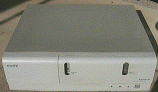
2004:
A Sony NeWS NWS-1750. 16MB RAM, CD-ROM player and 640MB
harddisk. In it is an NWB-514 video card. This system has one 68030
processor. I've installed NetBSD 1.6 onto it but sold it in
2005.
2004:
A Sony NeWS NWS-712 (diskless) with a Sony NWP-512D monochrome
A4 monitor. I guess I have to get the 1850 running with NeWS-OS
before I can get this thing to netboot. I sold it in 2005.
2004:
An HP Visualise C200 with 256MB memory and 2 4GB drives.
I've installed HP-UX 11.11 and sold it in 2005.
2004:
A Digital AlphaStation 200 4/233, 1GB disk, 136MB memory. I've
installed FreeBSD 4.9 on it. I sold it in 2004.
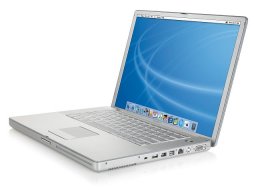
2004:
Apple PowerBook 15" SuperDrive with 512MB memory. This
system replaces my Sony Vaio notebook. It's a really, really
cool laptop. I like the combination of MacOS/Aqua and Darwin
very much. In 2005, I added 1GB of RAM, in 2006 I replaced
the drive with a 100GB 7200rpm model. A month later, it
was stolen :-( In retrospect, this must have been the
A1046 model.
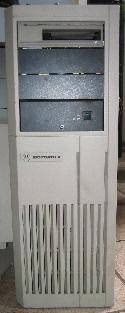
2004:
A Motorola VME tower with 147-SB1 (68030 CPU board @25MHz), 332XT
(parallel), 712A/AM (serial) and 712B (ethernet) boards.
It has a QIC-1350 drive and 2 660MB full-height drives.
It's running AT&T Unix System5 Release 7.3. I gave it away in
2005.
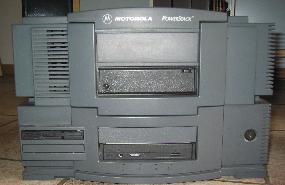
2004:
A Motorola PowerStack with two expansion units, both with a
525MB QIC drive. The system itself runs at 133MHz and it has
256MB of RAM, a CDROM player and 2 1GB drives in the main unit.
I installed AIX 4.1 on it. This is a very neatly designed
system. It is on indefinite loan.
2004:
A VME system from 1983 running ACE-UNIX V2. It was made by Dutch
firm Microproject and is called the loVME system. It has an RO-204
20MB harddisk, 5.25" floppy and a CDC-LARK drive (removable
harddisk with 25MB cartridges). I threw it away in 2005. Nobody
wanted it.. VME is dead?
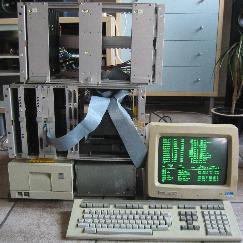
2004:
An IBM 5155 (Portable Personal Computer). It has 640KB RAM and
a bunch of ISA cards (Genius mouse, serial, floppy, parallel, CGA).
It has a 20MB Miniscribe SCSI harddisk but the controller is
missing and I don't have an 8-bit SCSI controller (yet). I
traded it in 2004.
45 2004:
Another Sun Ultra 5 (270MHz). No HD/memory. I put in 128MB
In 2005, I had a spare 40GB drive from my old server and
installed Solaris 10.
46 2004:
A Sun Ultra 10 Creator3D (300MHz) with 128MB memory but no
harddisk (yet). At first I thought I had blown up the CPU,
but I had only bent a single pin. It is now working. I eBayed
some memory, it now has 256Mb. After putting in a 30GB IDE
disk I was able to install Solaris 8. I also put in a
SunPCi (Penguin) card and that is now running Windows 98.
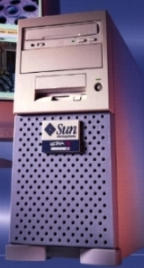
47 2004:
A Sun JavaStation-1, the 'Mr. Coffee' model with 8MB memory. I
put in 64MB. (Mine is blue).
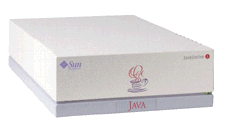
2004:
An Apple Macintosh Quadra 700. I put in 8MB memory and a 400MB
harddisk and installed A/UX 3.0 from original media (thanks
Jeroen Scheerder!). At first I couldn't get it to work (panic:
no root fs) but this was solved by.. using a slower CD-ROM
player. A/UX gigamac 3.0 SVR2 mc68040. I gave it
away in 2005.
2004:
An HP9000/300. It came with a Facit 4040 paper tape reader/writer!
It has a 68030 CPU at 33MHz (model 370), a SCSI board and
a video card. It has 16MB of memory. I intalled NetBSD 1.6.2
on an external 1GB SCSI harddisk (this was far from trivial as
the installer did not correctly see the disk). The Facit is
also still working, but I traded it for the book 'Open Minds
1982 - 1992' about Sun Microsystems. I did get another paper
tape reader/writer some time later. In 2005, I tried to give it
away. Nobody wanted it so I threw it away (a pity, especially
because of the SCSI card).
2004:
An HP150 system with a 9133 expansion box (15MB harddisk and
3.5" floppy drive) that is probably broken. The system is
extended with a built-in printer. The HP150 has a touchscreen,
i.e. there are infrared LEDs and LDRs beside the screen, forming
a matrix, that is used to detect an object (finger) being there.
I have no boot media so it's pretty useless now. I gave it
away in 2005.
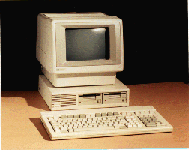
2004:
A MicroVAX 3100 m10e, 20MB memory, with a Storage Expansion
unit with 2 RZ56 (665MB) drives. I installed Ultrix 4.5 on
it but sold it in 2004.
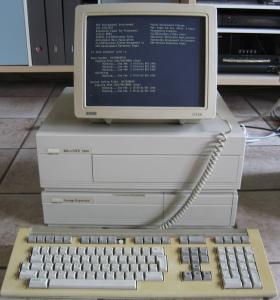
2004:
An Apollo 400s (68030 at 50MHz) system with 300MB harddisk,
48MB memory, EISA and two A1416 videocards. I couldn't get
NetBSD 1.6.2 to work so I installed NetBSD 1.5.2 succesfully.
I still have to get X running though. I also had a second
one which I gave away. I sold this one in 2005.
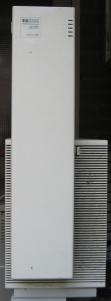
2004:
A Sun SPARCserver 370 (a/k/a Sun 4/370) with some graphical
boards from ISGtec. It didn't work at all. I threw it away
except for the mainboard, which hopefully is still okay. Maybe
I'll get a Sun4 case in the future.
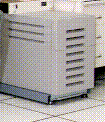
48 2004:
A Sun SunRay1. It boots from my Sun Ultra 30.
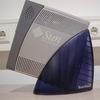
2004:
A Digital VAXstation 4000 VLC. 24MB memory, 1GB disk. I've
installed NetBSD 1.6. I traded it in 2004.
2004:
A Data General AViiON 4000 series. This thing has a Motorola
88k processor. It has 12MB RAM and a harddisk that did *poof*
when I turned it on. I replaced it with a (full-height) 1.2GB
drive. Installing is hard as there is virtually no information
on the web, strange. I finally found out (thanks Marden!) that
I should use 'b st(insc(),4)' to start the install process.
It gives weird errors (SCSI errors, can't find the disk etc.),
maybe it's the SCSI cable. I also had to solder batteries
to the NVRAM. I sold it in 2005.
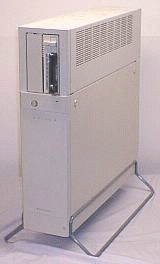
49 2004:
A Sun Ultra 30 creator3d with 248MHz UltraSPARCII processor,
2 9GB disks and 2GB memory, wow! I've installed Solaris 9.
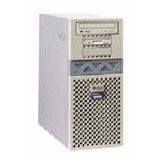
50 2004:
A Sun Ultra 1, 167MHz UltraSPARC, 384MB memory,
2 and 4GB disks, CDROM, dual-headed with an additional
100Mbps ethernet card. It's running Solaris 9.
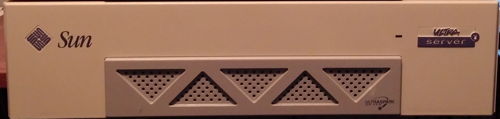
2004:
A Video Technology Laser 500 'color computer'. Looks like
a C64. I traded it in 2004.
2004:
An SGI Indigo2, 195MHz R10000 processor ('IMPACT'), 256MB memory,
4GB disk, Solid Impact graphics. This is a purple Indigo2 (my
previous ones were teal). I've installed IRIX 6.5.6. I got rid
of it in 2005.
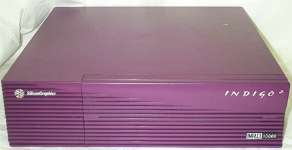
2004:
A Sony NWS-1250 laptop. 8MB RAM, 240MB disk. NeWS-OS 4.0C is
installed, but needs a registration number. I have a number
generator, but it's written in 680x0 assembly and none of
my (cross)assemblers or simulator grok it. I finally was
helped by Jean-Noel Petit, who happens to have a working
NWS-1250. After getting the registration number, I was able
to boot into single-user mode and crack the contents of the
password file. I sold it in 2005.
2004:
Another Sun SLC. 12MB RAM. The screen is a bit fuzzy. I gave
it away in 2006.
2004:
Another Sun SPARCclassic. I gave it away in 2006..
2004:
A Video Technology Laser 310 'color computer'. I traded it in
2004.
2004:
More Cisco stuff. A 1603 router with 4MB flash and serial card,
and an old AGS/2-2E2T4S-M5, loaded, being the old nl-gw.nluug.nl
(one of the oldest Cisco's in the Netherlands). I gave it to
Cisco Netherlands in 2005.
2004:
Another Sun 3/50. I gave it away in 2006..
2004:
Another Sun 3/50. With 68881 coprocessor and a Parity Systems
16MB memory expansion. I gave it away in 2006..
51 2004:
A Sun Netra i5. This is just a SparcServer 5 but with a
different label on the front. 256MB memory, 2 1GB disks,
Solaris 7. In 2005, I put in a SunPC card (133MHz 586).

52 2004:
A Sun Ultra 1 Creator3D. Untested yet.
2004:
A Sun SPARCclassic. I gave it away in 2006..
2004:
An HP 715/100. I traded it.
53 2004:
A Sun SparcStation 5, 170MHz, 64MB RAM, 0.5GB disk.
54 2004:
A Sun SparcStation 4, 85MHz, no RAM/disk. Untested yet.
55 2004:
A Sun Netra i4 (110MHz). 64MB memory, CDROM, floppy, no harddisk.
I put in a 4.2GB disk and upgraded to 160MB RAM and installed
OpenBSD 3.5. I also installed a 711 diskpack with a bunch of
4.2GB drives. In 2018 I turned it on again, the NVRAM battery
had died so I fixed that.
2004:
An SGI Indy R4600 without disk. I traded it.
2004:
An HP 715/100XC. I sold it in 2005.
2004:
A Sun 3/60. I gave it away in 2006.
56 2004:
A Tadpole SPARCbook (1). 16MB RAM, 120MB harddisk. It
currently runs SunOS 4.1.2.
I've made a copy of the
S1MON EPROMs.
57 2004:
A Sun Ultra 2. It has 2 200MHz CPUS, 256MB RAM (which I upgraded
to 576MB), CD-ROM drive, 4+9GB disks. It ran a special Xerox
version of Solaris 2.6. I re-installed FreeBSD 5.3 and later
OpenBSD 3.6, but on neither, the X Window System worked, so
I eventually installed Solaris 8. In 2005, I put in 2 400MHz
CPU's, increased memory to 1280MB and disk to 2x 9GB and
I installed Solaris 9. In 2014, I booted it but could no
longer log in (forgot the password) so I reinstalled
Solaris 10.
58 2004:
A Sun SparcServer 1000 with 4 CPUs and 256MB RAM. I put in
a 1GB disk and installed Solaris 2.3. In 2015, I got
a Sun SparcStorage Array 100. That now has 2 SUN1.05G disks,
12 SUN2.1G disks, 9 SUN4.2G disks, 1 SUN9.0G disk and 4 SUN18.0G disks
(only 16GB accessible).
ss1000# /opt/SUNWssa/bin/ssacli -v display /devices/io-unit@f,e0200000/sbi@0,0/SUNW,soc@1,0/SUNW,pln@a0000000,7412fe:ctlr
    - Getting state information from SPARCstorage Array
        /devices/io-unit@f,e0200000/sbi@0,0/SUNW,soc@1,0/SUNW,pln@a0000000,7412fe:ctlr
        - Verifying Controller is healthy
                Controller is a:SUN       SSA100
        - Reading state of each drive
        - Reading vendor's information and capacity from each drive

                    SPARCstorage Array Configuration
Controller path:/devices/io-unit@f,e0200000/sbi@0,0/SUNW,soc@1,0/SUNW,pln@a0000000,7412fe:ctlr
                          DEVICE STATUS
      TRAY 1                 TRAY 2                 TRAY 3
slot
1     Drive: 0,0             Drive: 2,0             NO SELECT
2     Drive: 0,1             Drive: 2,1             Drive: 4,1
3     Drive: 0,2             Drive: 2,2             NO SELECT
4     Drive: 0,3             Drive: 2,3             Drive: 4,3
5     Drive: 0,4             Drive: 2,4             Drive: 4,4
6     Drive: 1,0             Drive: 3,0             Drive: 5,0
7     Drive: 1,1             Drive: 3,1             Drive: 5,1
8     Drive: 1,2             Drive: 3,2             Drive: 5,2
9     Drive: 1,3             Drive: 3,3             Drive: 5,3
10     -                     Drive: 3,4             Drive: 5,4

                          CONTROLLER STATUS
Vendor:        SUN
Product ID:    SSA100
Product Rev:   1.0
Firmware Rev:  3.12
Serial Num:    0000007412FE
Accumulate Performance Statistics: Enabled
In 2026, I started playing with it again. Some disks had died and I could not (easily) figure out how to get the volume manager working. So, I decided to newfs all disks invividually. They were all named /dev/rsdXX. After I had newfs'ed /dev/rsd04c, it turned out that was a link to c0t0d0, the root disk... so I b0rked the whole OS. I spent days to get it up again.. booting from CD failed (both internal and external). I don't know why. I tried to make a boot server from FreeBSD but that failed. Interesting fact: using cpio to copy over character devices from the CD image to the (zfs) filesytem fails. I then tried to just mount the ISO file and export that via NFS but was still unsuccesful. I did trigger a bug cashing a FreeBSD panic. I then tried sunboot on FreeBSD but it wouldn't work. I installed Linux but still no luck. I finally took a genuine SPARC server (U10) with Solaris 9 and turned that into a Jumpstart server. This was not easy either, but in the end I could netboot into Solaris 2.6, only to find out that my SSA software will not run on 2.6. So, I put Solaris 2.4 on my JumpStart server (again, not easy) and tried to install that. It failed, late in the installation process (it could not write the vfstab file). Then I put Solaris 2.3 on the JumpStart server and this time, .. I got another error during the installation. Next (after phsycially destroying my Apple SuperDrive making a Solaris 2.5.1 CDROM), I used my SCSI2SD to emulate a CDROM drive with the Solaris 2.5.1 CD in it. That finally worked. Since the box was open, I took the opportunity to add a 2GB disk.
59 2004:
A Sun SunScreen SPF-100. There was nothing in it. I put in
256MB memory and 2 0.5GB disks and a cgsix framebuffer and
installed OpenBSD (this is supposed to be a firewall system,
right? :).
2004:
A Sun SPARCserver 3x0 in a SPARCserver 630MP enclosure. The
CPU board has 32MB RAM and there is a Solflower SF330MEM memory
expansion board in it with another 64MB RAM. It has 2 330MB
drives, a color graphics card and a SCSI/Ethernet expansion
board as well. I gave it away in 2006.
2005:
Another Motorola PowerStack. It runs at 133Mhz, has 256MB RAM,
CD-ROM, 2GB disk, 525MB QIC and DDS tape drives in an expansion
unit. I installed AIX 4.1.4 but am planning to install Solaris
later (so it fits in the Sun collection ;-). I never got to
that.. couldn't get it to work and gave the system away in 2012.
60 2005:
An Axil SparcStation 5 clone. Untested yet.
2005:
A DEC Multia. I put in a 810MB 2.5" SCSI harddisk and installed
OpenBSD 3.1. I sold it in 2005.
2005:
A Sun SparcStation ClassicX. I gave it away in 2006.
2005:
Another Sun SparcStation IPC. I gave it away in 2006.
61 2005:
A Sun E450 with 4x400MHz CPUs, 12x9GB disk, 2GB memory. It runs
Solaris 10. Later, I upgraded to 4GB RAM and put in 10x36GB and
10x18GB disks. It is currently at Student Society GEWIS.
62 2005:
Another Sun SparcStation 10. It has 2 50MHz CPUs, 272MB RAM
and 2 disks (4+9GB). It runs Solaris 9.
63 2005:
A SunBlade 100 (128MB RAM, 15GB disk). I've installed
Solaris 10 and upgraded RAM to 768MB (it took a long time
before finding out registered memory needs jumper JP6
to be installed).
2005:
A Sun Enterprise 250. It has 2 400Mhz CPUs, 1GB RAM and 2
18GB disks. It has a Raptor GFX graphics card and also came with
two D1000 StorEdge's (one has 12x 4.2GB, the other has 6x 18GB
and 6x 36GB). I replaced the disk with 6 9GB disk and
installed Solaris 10. Eventually, I put the memory and CPUs
in my Ultra 2 and sold the remains.
2005:
Another Sun Ultra 30 creator. 250MHz, 512MB RAM and 2 SUN4.2 disks.
I gave it away in 2006.
2005:
Another Sun Ultra 30 creator. 250MHz, 512MB RAM and 2 SUN4.2 disks.
Scrapped in 2012..
2005:
Another Sun E450! This one has 2x250MHz CPUs and 512MB RAM.
There's plenty of SCSI cards in it and there are 20 9GB disks
in it (and a DDS3 streamer). I traded it for a Blade 150.
65 2005:
Another Sun Ultra 5. 400MHz, 256MB, 9.1GB disk. I've installed
Solaris 9.
2005:
A Sun SunRay 100. In 2026, I tried to boot it and it no longer
works. I scrapped it.
2005:
An HP9000 series 8000 E25 sytem. 48MHz RISC processor, 64MB RAM,
2+1+1GB disks, CDROM, 4GB DDS drive. It runs HP-UX 10.20 but I
upgraded to 11i which is not doing well with 64MB. Later I
got some extra memory and upgraded to 192MB. Scrapped in 2012.
67 2005:
A SunBlade 150. It has 640MB RAM and a 40GB harddisk. I've
installed Solaris 10 and used it at work for a while. Later I added a
SunPCi II card ("Chimera", 600MHz Celeron PC card).
2005:
A Sun 3/160. It has a "Carrera" 4MB CPU board and a 4MB memory
expansion. The QIC drive has a bad tape roll, one of the two
ESDI drives won't spin up (both are 141MB). It was running
SunOS 4.1. I swapped the tape drive with my only working QIC-11
drive and installed SunOS 3.5 from original tapes from 1987,
still working like a charm! The only thing is, the ethernet
doesn't seem to work. I gave it away in 2006.
2005:
Another Sun E450 with 2x300Mhz, 4GB RAM, 4x36+6x18GB drives
and a 1000BaseT card. I've used all the CPUs/RAM/drives to
put in other systems.
68 2005:
A Fujitsu S4/5 model 110. This is actually a Sun SparcStation 4
with a Fujitsu badge.
2005:
A whole bunch of IBM RT stuff which I gave away some time
later.
2005:
A Eurocom-1 single board computer from Eltec in a nice wooden
case made by Manudax.
70 2006:
An RDI Powerlite (or is it a Britelite-LX?). This is a Sparc in
laptop format. The system says it's a Powerlite, but the CPU
is a 50MHz TMS390S10 microSPARC, which corresponds to a
Britelite-LX. It has 48MB RAM, a 1.2GB and 810MB harddisk,
floppy, modem and 1024x768 colour screen (cg3 graphics). It runs
Solaris 2.6.
2006:
A Toshiba Portégé P3500 tablet PC. I upgraded the
drive with the drive from my (now stolen) PowerBook. The CPU
fan broke and you know what? NOBODY will sell you a spare fan
(except people in Australia who only ship to Australia, a fan
costs about 8AUD there). I have
to pay more than 10 times that to have it repaired, and they
killed the 512MB simm that's in it :(( I gave it away in 2010.
71 2006:
A MacBook Pro 15" (A1150) to replace the PowerBook that was stolen.
I upgraded to 2GB RAM immediately. In 2007, I put in a 200GB
drive. Later, I killed it by pouring coffee on it. The screen
is a bit damaged. The WiFi stopped working. The keyboard
is sticky and the backlighting fails but I replaced it in
2010 when the new MacBook died. It is still running 10.6.8.
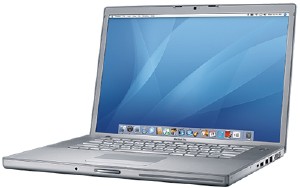
72 2006:
A Sun "Mr. Coffee" JavaStation-1 in white. I already had a
blue one.
73 2007:
I decided to buy a new server to replace the Celeron system
I bought in 2002. The main goal was to reduce the amount of
power used. To do this, I removed all DVD/CD/floppy/tape drives,
use only one hard drive instead of two, removed the video
card (serial terminal) and use only one SIMM. For backups,
I now use the old giga.giga.nl system, which has become a
dedicated backup server that is normally not switched on. The
new giga.giga.nl still runs FreeBSD 6-CURRENT, but using the
following low-power hardware: Asus K8N4-E SE motherboard,
AMD Mobile Athlon 64 3200+ CPU, 320GB SATA drive, 1GB memory
and a special SilentMaxx fanless power supply. By using a
wireless PCI card, I eliminate the need for a dedicated wireless
base station. Also, I have upgraded to Gpbs networking.
As serial terminal, I am using an ADM-3a :-) Just after
installing FreeBSD, the system completely stopped working. I
think the CPU has blown :( I ordered a replacement AMD Mobile
Turion 64 MT-34. The system still has problems: it will crash
every few days. If I can't fix it, I will buy a Soekris :-/
Also, the built-in wireless stuff doesn't work as I cannot find
a decent card that is supported. The panics were solved by
disabling IPv6. The FreeBSD/IPv6/NAT/firewalling problem has
now haunted me long enough (since end 2002). The wireless
is now done using an Apple Extreme basestation (802.11n).
The ADM3a is not used anymore, because it leaks power and trips
the safety. In 2008, I upgraded to FreeBSD 7.0. It now runs
8.x-STABLE. In 2011, I replaced it with a fit-PC2i.
74 2007:
A Sun Netra T1 model AC200, with 500MHz CPU, 1.25GB RAM and
2 36GB drives. I could not get a CDROM to work so I decided
to do a net-install. I used the next item for this, it took
me some time to get it all working in conjunction with my
FreeBSD DHCP server.
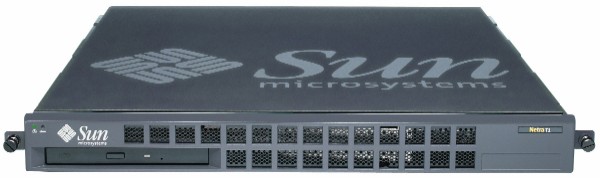
75 2007:
A Sun Netra T1 model 105, with 440MHz CPU, 1GB RAM and
2 18GB drives. I've installed Solaris 10. In 2021, I upgraded
to 2 72GB drives and added a CDROM player and additional network
card.
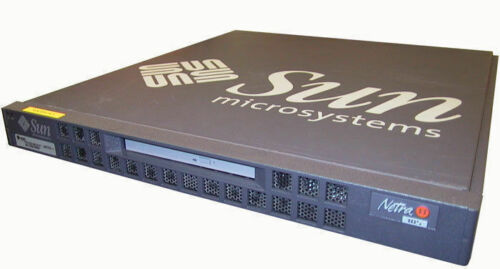
2007:
A 1U server that I've put in colo. It's an Asus RS100-E4/PA4
with an Intel Quad Xeon 2.13Ghz, 4GB ECC RAM and 2 750GB in
RAID1 setup. It runs FreeBSD 7 and is my main mail/web
server. In fact, it runs about 9 web servers in different
jails. In 2010, after a nasty crash due to a double power
failure, I upgraded to FreeBSD 8 and software RAID 1 on
2 2TB disks. In 2011, it suddenly died. I bought a new system.
2007:
Aargh! I spilled coffee over my MacBook Pro and killed it..
I bought a new one (2.4GHz, 4GB RAM, 200GB drive). In 2009
I put in a 500GB drive and in 2010 I upgraded to 6GB RAM. In
2010, it broke down and I bought a new one.
76 2009:
An Asus eeePC 1000H. I've bought a Broadcom BCM94321MC wireless
netwerk card to replace the built-in card and upgraded to 2GB
RAM. I've installed Mac OS X next to the standard Windows XP.
2009:
A MicroVAX 3400. I built in a cooker so I could do
"make egg". This was presented at the HAR hacker
conference (and afterwards shredded).
2009:
Some VME system which turned out to be an ISG Allegro system,
used to process graphical data from MR PET scans. Unfortunately,
the system was completely dead when I got it.
2009:
A Sun SunFire V440. 4x 36GB disks, 4GB RAM, dual cpu (1.062GHz). I've
installed Solaris 10 and use this to replace my Blad 150 as
SunRay server. I put in 2 extra CPUs with an extra 4GB RAM from
the other SunFire V440 I got. One of the PSU's has stopped
working. In 2014, the other PSU stopped and I threw it away.
2009:
Another Sun SunFire V440 with 4x 36GB disks and 4GB RAM, dual cpu.
I've put the CPUs into the other V440.
2009:
A Sun SunFire V480. 4GB RAM, I've put in 2x 36GB disks. Since
it is so big, I shredded it in 2014.
2009:
A Sun SunFire 280R with 1 CPU and 1GB of RAM. I've put in 2x
36GB disks, but hadn't gotten to play around with it until 2014
when I got another 280R. I put the memory of this one in the
other one and threw the remains away.
77 2009:
An Asus eeePC 1005HA running Windows 7. I won it at Hack.lu
and gave it to my wife. I got it back in 2017. I've turned
it into a car-hacking system.
78 2009:
A Palm Pre phone/palm device/GPS/.. to replace my Sony Clie and
my telephone. Since it's running Linux, I'm adding it here.
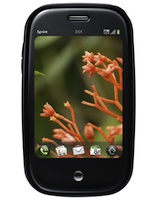
79 2010:
Wow! A Sun TEMPEST SparcStation 2 (T-SPARCstation 2 or T2). I didn't
even know they existed until, after a talk with Whitfield Diffie,
he donated his box to me (the monitor was given to a museum). It
then took 2.5 years to get the thing from the USA to here (thanks
Joep Vesseur!). The box has two drive bays, but no disk trays. Inside,
it's a regular SPARCstation 2 with 64MB RAM and a cgsix. I thought
for 16 years it was riveted shut, but these are actually tiny
torx screws. After opening it for the first time in 2026, I was
able to clean all the dust and fix the dead NVRAM. It would
be nice to get disk trays, but the system uses Hypertronics
29-pin KA type plugs, so I guess they will be unobtainium.
The system has a 501-1645 CG6 frame buffer.
I have a small gallery
with pictures.

80 2010:
A SunBlade 2000. It has one CPU (UltraSparc III+), 2GB of
RAM and two drives (72+36GB) and a Chimera PC board.
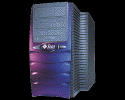
81 2010:
My MacBook Pro suddenly stopped working. Seems to be the main
board :( I bought a new one (A1286, 2.66GHz, 4GB RAM, 500GB drive).
I immediately upgraded to 8GB RAM and later put in a 750GB drive.
It's running 10.11.6.
82 2010:
A Sun 3/110. It has 24MB memory thanks to a clearpoint memory card,
and it has a SCSI adapter. This was the first Sun with color
output (1987). It has no hard drive attached so no OS is
installed at the moment. In 2018 I tried to boot it. The fuse
blew so I had to put in another. The PSU kept on working. I
attached a SCSI2SD with a sun3 install of SunOS 4.1.1U1 but
it wouldn't see the drive. I took the 501-1045 board out of
the SCSI board and swapped it with a 501-1236 I happened to
have lying around. With that, it does talk to the SCSI2SD, but
it doesn't want to boot (Bus timeout). That turned out to
be bad contacts in the casing. A bit of reseating fixed that.
It can now boot SunOS 4.1.1U1.
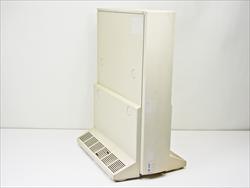
83 2010:
Another Sun 3/50. 4MB RAM. It came with a Helios RAM expansion
board (8MB).
84 2010:
Another Sun SparcStation 10.
85 2010:
A Tatung Super COMPstation 7/30 (SS10 clone) with 50MHz CPU,
32MB RAM, 1GB drive, cgsix. Haven't really played with it yet.
86 2010:
A GoldStar GWS-20, 64MB RAM. It hadn't been used for a while
(WARNING: clock gained 3867 days -- CHECK AND RESET THE DATE!) :-)
Haven't really played with it yet.
87 2010:
A TRITEC SparcStation 20 clone with a 40MHz SuperSPARC CPU, 64MB RAM
and two 2GB disks. It has a TurboGX framebuffer.
88 2010:
A replacement for zoei.giga.nl. Intel core i3-530 CPU, 4GB RAM,
640GB disk, nVidia GeForce GT220 video card, Gbps ethernet and
some other stuff. In 2016, I put in a GeForce GTX660 video
card, in 2019 I upgraded to 8GB RAM and 512GB SSD and made the
system dual boot Windows 7/Windows 10, as this is the system I use
to run software that is only available on Windows. In 2025,
I maxed out the RAM with a whopping 16GB total.
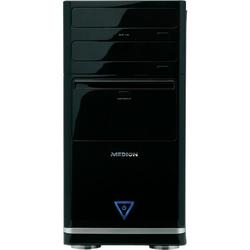
2011:
A 1U server that I've put in colo. It's a Supermicro
with two Intel Dual Xeon 3.20Ghz CPU's, 4GB RAM and 2 2TB in
RAID1 setup (replacing the ASUS that crashed). It is my main mail/web
server. In fact, it runs about 9 web servers in different
jails. Currently on FreeBSD 8-STABLE. In 2012, I replaced it
with a new server to decrease the power usage and sold it.
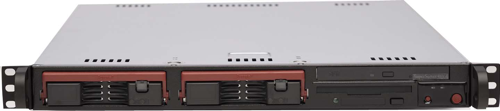
89 2011:
A second-hand 1U server just in case the SuperMicro breaks.
It's an Asus RS100-E4/PA4 with an Intel Quad Xeon 2.13Ghz,
4GB ECC RAM and 2 500GB disks.
90 2011:
A fit-PC2i system (Intel Atom Z550 CPU at 2GHz, 2GB RAM,
2x gigabit ethernet, wireless, 750GB harddisk) to replace my
home server (giga.giga.nl). This baby is super efficient with
power. Thanks to the built-in wireless, I no longer need a
separate access point, saving even more power. The 750GB disk
is a WD Scorpio Blue. I started with FreeBSD 8-STABLE. In 2012,
I upgraded to FreeBSD 9-STABLE. Also, the wireless turned out
to be crappy (at least, the FreeBSD driver for it) so I'm
still using an Apple Airport via a USB-ethernet connection
for that. In 2014, I upgraded to a fit-PC4
91 2012:
A SunBlade 1000 (750MHz, 2.5GB RAM). It had an 18GB disk
which I replaced with 2 36GB drives. I wanted to install
Solaris 11, but it didn't like the hardware.. so I settled
for Solaris 8, which was originally on the machine.
In 2026, one of the drives had broken. I re-installed
OpenBSD 7.8 onto it.
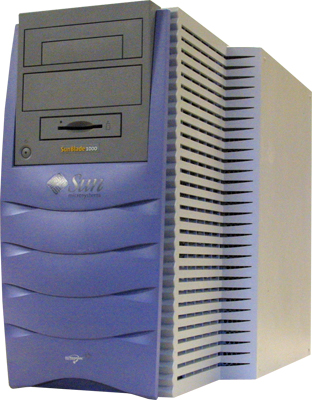
2012:
My SuperMicro turned out to use 0.8A and I have to pay per 0.1A
in the datacenter.. So I bought a new 1U server with an Intel
Core-i3, and 16GB RAM and put in my original 2x2TB disks. This
Chenbro sever was replaced with an HP in 2015. This was a spare
until I bought a new 1U server.
92 2012:
A SunBlade 2500 Silver. Dual 1.6GHz CPU, 2GB RAM, 146GB disk,
XVR-100 graphics.
I wanted to install FreeBSD 9.0 on it, but that didn't support
the video card. Then I wanted to install OpenSolaris 11, but that
doesn't support UltraSPARC-IIIi CPU's. Sigh. I've ended up
with Solaris 10. In 2014, I added a 72GB drive. In 2018,
I reinstalled Solaris 10 U11 to make it a Jumpstart server.
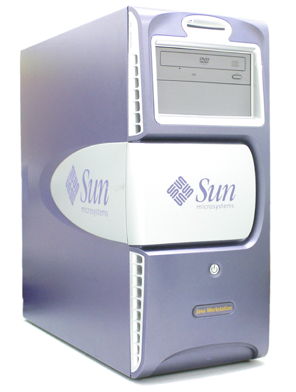
2013:
A Digital DNARD (DIGITAL Network Appliance Reference Design),
also known as the 'shark'. 32MB RAM, 1.5GB harddisk, running
NetBSD 1.6. It went to Bulgaria in 2026.
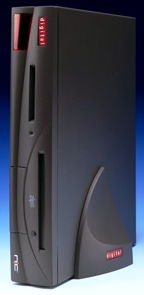
94 2013:
Another Sun SparcStation 1. This one has no disks nor a
framebuffer and only 4MB of RAM. Also, the fan makes bad noises.
But: the NVRAM is still alive:
ROM Rev. 1.3, 4 MB memory installed, Serial #16379.
Ethernet address 8:0:20:7:93:b, Host ID: 51003ffb.
95 2013:
A Tatung Micro COMPstation TWS-2050 (SS5 clone).
It has 16MB of RAM, no disks and a cg3 framebuffer (and an
empty NVRAM).
96 2013:
Another Sun SPARCstation Voyager. It has 64MB RAM, an 810MB
drive and a cgsix framebuffer! It also includes a battery,
keyboard, mouse and carrying case. It was running NetBSD 3.1
when I got it; I upgraded to 6.1. The NVRAM needs fixing.
When I tried to boot it in 2021, it turned out the LCD display
no longer works. The external 13W3 connector gives output though.
The screen's backlight was not working. I tried swapping the
screen with that of my other Voyager to determine where the
fault was, possibly fyring the other screen as well :-(
97 2013:
My MacBook Pro was 3 years old, so I bought a new one (A1398). So
this time I have time to install everything while still using the
old one. (Previously, my MacBooks broke or got stolen). This has
has a 2.6GHz processor, 16GB RAM and 1TB SSD drive. Maxed out,
since you cannot add a lot once you've bought it. In 2018 I spilled
a cup of coffee over it. I considered bying the new MacBook,
but it is 600 euros more for the same specification as this one,
comes with much less I/O possibilities and has the OLED bar
on top so no ESC key. I bought a new keyboard and backlight
and changed it myself. That was quite some work I can tell.
But the system is still going strong!
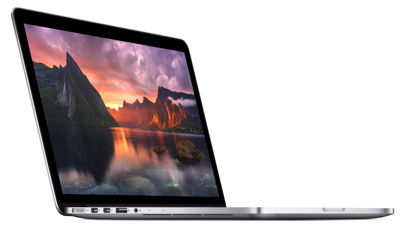
2014:
A Sun SunFire 280R with 2 CPU's and 2GB of RAM and 2 36GB disks.
I put in an extra GB of RAM from my previous 280R and installed
Solaris 10 on it. It's actually a bit too big to keep in the
collection so I shredded it in 2014.
98 2014:
A Sun SunFire V100 with 1GB of RAM and a 40GB disk. I added a
80GB disk I had lying around. For the installation, the first
bootable CD I found was OpenSolaris 11, but it wouldn't install
on this hardware. I made a FreeBSD 10.0 CDROM and used that
to install a working OS on it. In 2026, it would no longer boot.
I've reinstalled OpenBSD 7.8 onto it.
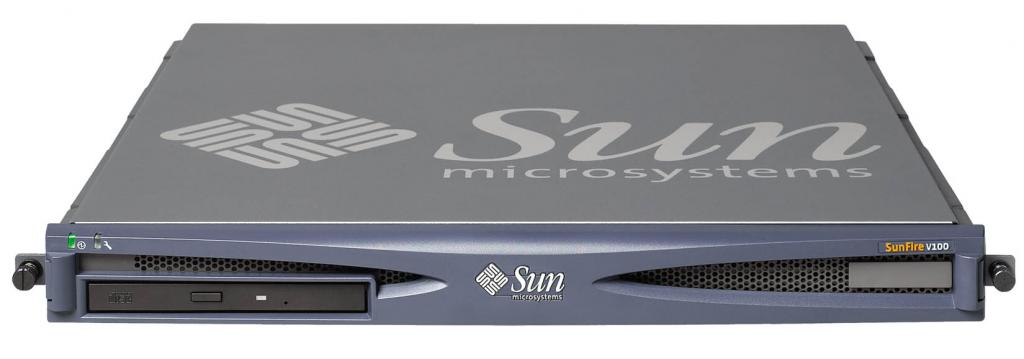
99 2014:
A Sun Netra T2000. Wow, this thing is packed! 8-core 1.2GHz
UltraSPARC-T1, 16GB of RAM and 2 146GB drives. I've installed
Solaris 10.
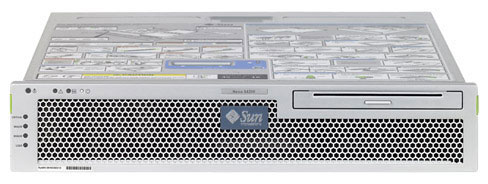
100 2014:
A fit-PC4 system to replace the fit-PC2i. It has a 1GHz AMD
CPU, 16GB RAM, dual Gbps ethernet ports and a 1TB disk. I replaced
the internal WiFi card for an Atheros card. However, the FreeBSD
driver is not up to it. I've reverted to using an external base
station. I've tried using a USB3 ethernet adapter, but its performance
was worse than an older USB2 adapter I had (the driver is too
new I suppose). I upgraded to FreeBSD 10, in 2016 to FreeBSD
11, in 2019 to FreeBSD 12 when I also replaced the harddrive
with a Samsung EVO 1TB SSD drive. It currently runs FreeBSD 14.2.
In 2022, I replaced this system with a Qotom device, that
has 4 on-board ethernet ports, so I don't have to resort to
USB ethernet. This machine is now a nice small box to use
whenever I need something quickly, like an NFS bootserver.
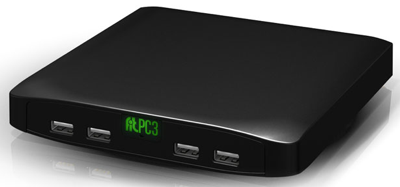
101 2014: Another
3COM Palm III handheld (19Mhz dragonball, 2MB RAM).
102 2014:
A SunBlade 1500. I now have all SunBlades (100, 150, 1000, 1500,
2000 and 2500) in my collection. This one has 4GB RAM, 80+320GB
disks and XVR-600 graphics. It had Solaris 10 installed and I
only had to guess the root password to get in ;-)
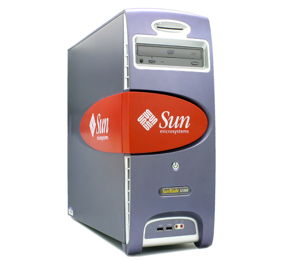
103 2014:
A SunFire V250. An interesting system, as it is a server in a
deskside cabinet. It has 2 1.28Ghz CPU's, 8GB RAM and came
with 4 72GB disks. I added 4 18GB disks and installed
FreeBSD 10. There's also a Penguin (SunPCi 400MHz) board
in it and I added a Gbps NIC.
In 2026, FreeBSD wouldn't boot anymore. I put Solaris 10 on it.
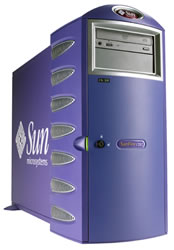
104 2014:
Another Sun Ultra 1 with 167Mhz CPU, 2x2GB disks and 128MB RAM.
I had to re-seat the SIMMs as I got memory errors. Also, the NVRAM
is dead. One of the disks makes a terrible noise and the system
doesn't want to boot. I've left it as it is for now.
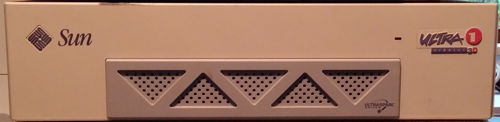
105 2014:
Another Sun SparcStation 10. Two 1GB drives, empty NVRAM,
cgsix framebuffer, 128MB RAM. What is interesting, is that
it has some prototype of the combined SCSI/ethernet SBUS
card (501-2016) with piggybacked chips on it. I took the first
OS I could find which happened to be Solaris 1.1.1 and had to
fix the host type in NVRAM to get it to boot. However, I got SCSI
errors, looks like termination problems, but it could also
be the NVRAM. I swapped it with the NVRAM of my other SS10,
but that was dead as well ;-/ I dug up the trusty soldering
iron and fixed it. It then turned out the SCSI-problem was due
to the CDROM using a too large blocksize (weird, since I had
also tried a genuine Sun CD-ROM player, the one with trays).
This was solved by installing Solaris 7 instead, which is what
it is now running happily.
106 2014:
Another Sun SunRay 1.
107 2014:
Looking at my collection, I noticed a SunRay 1G standing around,
don't remember where/when I got it?! The difference with the
SunRay 1 is that the 1G has better graphics (via DVI instead
of VGA).
108 2014:
A SunFire B1600 chassis with a whole load of blade modules:
10 B100x units (AMD Mobile 1800+ CPU, 2GB RAM, 30GB disk) all
running Linux (but one sometimes has problems with the console).
There's also 6 B100s (UltraSPARC IIe 650MHz) units, 4 of those have
2GB RAM and a 30GB disk, of which one has a faulty disk (I put in
an old 12GB drive), 1 has 1GB RAM and one
is empty (no CPU, RAM or disk). I had to hack into the SSC
(disconnect one of the PSU's and you can log in as admin without
password - neat). Booting the AMD blades from the
network was also not easy. I couldn't get into the BIOS by pressing
F2. Eventually, I found out that from the console, you can
enter bootmode bootscript="boot net" s0 and
then reset s0 to get it to do a netboot. After setting
up a PXE boot server, it took me a few more hours to get it to
use the serial console and to find out that FreeBSD's sysinstall
has been replaced by bsdinstall. I've installed FreeBSD 10.1 on
the AMD blades (except for one that doesn't seem to work). The
SPARC blades also took some work. I had to find out how to
install a JumpStart server, and how to netboot from the
secondary ethernet (boot /pci@1f,0/network@b - install).
Also, during boot I'd get a /sbin/install-discovery: information:
not found but entering exit on that error worked.
Later, I bought 2 b100s blades on eBay with 30GB drive and 1GB
memory and I installed Solaris 10 on those as well, so there's
now 16 working blades in there.
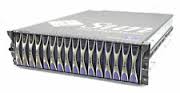
2014:
An Apple Network Server 500/132 running AIX. 96MB RAM, 2 and 4GB
disks running AIX 4.1.3. I didn't have the root password.
The boot disk is a Wide SCSI disk (68pin) and I could not find a
way to hook it up to another existing system. I ordered an
68-50 pin converter and hooked it up (with proper termination) to
a Sun, but it didn't get recognized (although a LED on the drive
lit up). When using another 68-pin disk in the same enclosure with
the same cable/terminator, it DOES work. I was stumped. A month
or so later, I tried again and found out it had to do with SCSI
termination jumpers on the drive itself. I was able to read the
disk (using a PC with a SCSI card I got -- thanks Hans) and then
it took a few minutes to remember the AIX 4.1.3 shadow file
format is different from other systems. A hashcracker cracked
all the passwords and I was able to log in! There was a few years
of correspondence from a small law firm from Zwolle on it that
was removed but since the disks are journalled... I gave
it away to an Apple collector in 2015.
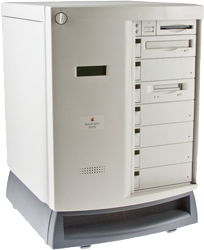
109 2014:
Another Sun SparcStation 4 (110Mhz), 9GB disk, 160MB memory,
audio module, CD-ROM, so pretty much maxed out. I installed
OpenSTEP 4.2 just for the fun of it. (Note to future self:
switch to SPACE parity during install.)
2015:
A Zenith miniSPORT ZL-1. An 8088 MS-DOS portable with LCD screen.
The most unique feature is the use of a 2" floppy drive.
It also has an external 3.5" floppy drive. Unfortunately, it does
not boot up, although the external PSU is working. The BIOS batteries
(uncommon CR2325 type) are empty, but putting an external 3V source
did not do the trick. After opening the thing up. it seems to be
a failure in the internal PSU. I cannot find it however, it's not
the capacitors. The documentation online didn't help either. It
looks like several components are faulty. Disposed.
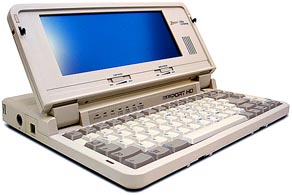
110 2015:
An HP 1U server. It's a DL120 (9th gen) with 36GB memory. It replaces
my Chenbro server that started to behave flakey and was running
out of memory. It's still running FreeBSD 10.1, but I upgraded to
ZFS. After the first boot, the system would panic with the
message "panic: APIC: CPU with APIC ID 0 is not enabled". It took
me a while to fix this. I had to disable x2APIC support in the
BIOS (System/Processor options).
In 2017, I upgraded to FreeBSD 11 (11.0 but a month later to 11.1):
[~] walter@yotta> uptime
9:12AM up 651 days, 11:59, 1 user, load averages: 0.41, 0.52, 0.51
In 2018, one of the disks was giving errors, so I upgraded from
2TB mirrored to 4TB mirrored (with ZFS this could easily be
done by replacing the disks one by one and then growing the FS -
no downtime!). Unfortunately, the next time I rebooted, it would
not come up, as I still had MBR instead of UEFI and MBR could
not boot from disks over 2TB. So that costs me a lot of extra
work. I've also upgraded to 68GB of memory in 2018. In 2022,
the disk size was increased to 14TB. It currently
runs FreeBSD 14.1. In 2024, I replaced the system with an
HP DL360 (10th gen). This system is now a spare.

111 2015:
A Sun Ultra 20 with an AMD 1.8GHz Opteron, 1.5GB RAM, 40 and
80GB drives and a DVD-ROM. I've installed elementary OS Freya (a
Linux Ubuntu clone) on it (well - I *think* it's installed,
it chose a resolution my monitor does not support). This is the
only Linux system I have (apart from a VM and mobile phones).
In 2026, I booted the system again and found that the disk is
encrypted with LUKS to which I do not have the password. I
installed FreeBSD 15.1 on it.
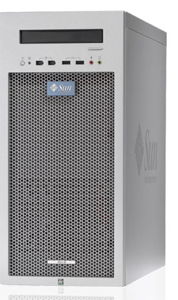
112 2015:
A Sun SunFire V210. It has a dual UltraSPARC IIIi CPU, 4GB RAM
and 2 72GB drives. I've swapped the PSU as the current one was
a bit flakey. I wanted to install OpenSXCE 2014.05, just for the
fun of it, but it wouldn't, so I stuck with Solaris 10.
Note to self: open front bezel to acces the power button
to boot the actual system. One of the drive has failed, I replaced
it with an 18GB drive and re-installed Solaris 10.
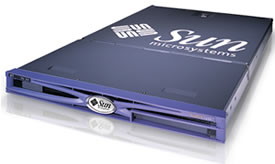
2015:
A Sun SunFire V20z. It has 2 AMD Opteron 2.6GHz CPU's and
6GB of RAM, as well as 2 72GB drives and CD-ROM. I've installed
FreeBSD 10.1. In 2018, I turned it on and it had problems with
the SCSI controller so I scrapped it.
113 2015:
A Cobalt Qube 2. I couldn't get anything useful from the serial
port, so I booted and connected another system to hack it
from the network. I was able to get root access. The system is
running Linux on a 20GB hard drive. However, it suddenly
hung and I haven't been able to boot it since. Also, the
console won't give my anything but gibberish, whatever settings
I use. It now hangs in the "Starting up" mode indefinately.
In 2026 I tried again, it was still hanging in "Starting Up". I
took out the drive, which no longer seemd to work. After
spending too much time with a Restore CD, I found a 10GB
disk image online,
and a 10GB disk in my pile of disks, I put the image on there
and now it works again!
114 2015:
A Sun Netra X1. 500MHz CPU, 1GB RAM, 40GB disk, running Solaris
2.8. Since I didn't have the root password, I had to re-install
an OS. I chose FreeBSD 11.0. Compiling took ages.
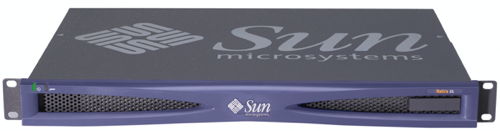
115 2015:
Another Sun Ultra 10. Haven't looked into it yet.
116 2016:
A Sharp Zaurus SL-C3100 running OpenBSD 5.0. This tiny device
has 64MB RAM, a 416MHz CPU and a 4GB microdrive.
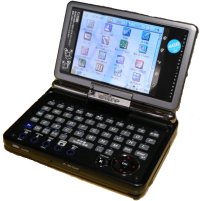
117 2016:
A Solair WS19L, which is a SparcStation 10 clone. It has one
75MHz CPU, 64MB RAM, 4GB disk and a cgsix framebuffer. The NVRAM is
empty. It was running OpenBSD 5.6 when I got it and that's what
I kept.
118 2016:
Another HP 9000/712. There's 128MB RAM in it and a 2GB drive
holding OpenBSD 5.9.
119 2016:
Another SGI Indigo2 (purple), 200MHz R4400 CPU, 48MB RAM. The disk
that was in it was broken. I put in a 9GB drive and installed
IRIX 6.5.15. It took a while to figure out the weird errors during
installation were due to the fact that there was no IRIX filesystem
layout on the disk, I had to partition it first. I traded it
in 2018.
2016:
A Sun 3/470. [I really didn't want any more systems this big
(pysically) but just had to rescue this one.] It contains a CPU
board with CG6 that appears to be broken, SCSI card, 32 and 8MB
memory boards. I added another 8MB that I had lying around. After
the use of a contact cleaner and a rubber hammer to insert the
boards tightly, it booted. It runs SunOS 4.1.1 from a 414MB
harddrive and it has an extra 300MB drive and a 60MB QIC tape
drive. I have re-installed a fresh SunOS 4.1.1_U1, upgraded the
boot PROM from version 2.9.3 to 3.0 and swapped the tape drive
with a CD-ROM drive. I've also tried to install NetBSD, but
no version would boot so I gave up. I gave it away in 2018 and
later also donated a frame buffer I got.
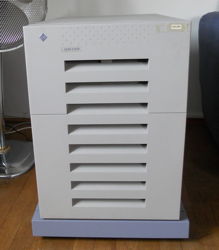
120 2016:
A Naturetech GENIALstation 737S. This is a 400MHz UltraSPARC-IIe
laptop. It has a 60GB drive and 512MB of RAM (the max for this
system). It was running Solaris 10 but I've installed
FreeBSD 10.3-RC1. Compiling xfce from source with all the
dependencies took quite some time (about a week) and then I found
out it wouldn't work with the video card, sigh. I then
reinstalled Solaris 10.
121 2016:
A Kontron PSI Ψ 9068 server. This is a multibus system that houses
a Sun 501-0600 CPU board, a 1MB memory board (501-0147)
and a Kontron Z80-based I/O board. There's a 20MB ST-255 drive
and a 5.25" floppy drive. The CPU is an 68000, which is interesting.
It means it is not a Sun-2 board (that one has an 68010) and not a
so-called "Sun 1.5" board, as that would be an 68010 board that
fits the original Sun 100. It has been said that Kontron bought
a bunch of old Sun-1 boards that came back from customers upgrading
to Sun-1.5 boards. The part number is pretty low (501-0600), the
oldest Sun-2 CPU board is the 501-1007 so that also indicates this
is an original Sun-1 CPU board. Vaughan Pratt wrote on USENET about
the Sun-1 systems (100 and 150): "Sun shipped about a thousand of
these, then replaced them all (at a price) with a redesigned
68010-based board so that it would not be necessary to support both
a vm and a non-vm unix [..]". Maybe some of them were indeed bought
by Kontron. When hooking up a terminal to the Sun CPU, I get:
KONTRON PSI 9068 Monitor (Rev C/V2.1 ) - 0x200000 bytes of memory
>b
Boot: dk(16,2)unix
Waiting for the IOP-Processor
Unfortunately, I did not know how to proceed from here. The system
has an "ECB" bus (Europe Card Bus), invented by Kontron. It has an
"XM" board for additional connections, which are not used. Searching
the web, I found that the 68000 is actually the main processor,
the Z80 is the I/O processor. So the error points to the Z80 board.
While playing with the serial cable, I suddenly saw "ath", "ats0=3" and
"atdt 2783775", is the I/O processor somehow using Hayes commands
to talk to the Sun board?
Some images are to be found here.
I made a dump of the boot ROMs.
In 2024 I bought old floppies with the KONTRON OS and
(part of) a manual. I bought a
greaseweazle and hooked it up to an old drive to read the disks.
I did not have high hopes, as the disks are from 1987. The disks
included KONTRON UNIX V2.4a and V2.5. I think I was succesful
in getting the data off of them. They are 616kB floppies (14 s/t,
256/s). The 2.4A disk contains:
(C) Copyright 1981 - UniSoft Corporation. Version: V2.4a
Linked at Thu Oct 24 15:13:47 MEZ 1985
The V2.5 disk contains:
(C) Copyright 1981 - UniSoft Corporation. Version: X2.5
Linked at Fri Aug 29 11:59:38 MESZ 1986
I did some further work. The Sun board seems to work, but needs
the IO Processor (the Z80 board). That board also seems to work
and it has a built-in debugger. The harddisk seems to work,
when connecting to an MFM module, although I could not make sense
of what is on the disk, maybe it has been wiped. The floppy drive
also works on the greaseweazle. But, from the debugger, I cannot
access the drives. Using the "TP" command, I get "DRIVE NOT READY"
or "CRC ERROR" for the Winchester drive. Could this be something
hardware related? I feel that once this is solved, I can do a
re-install.
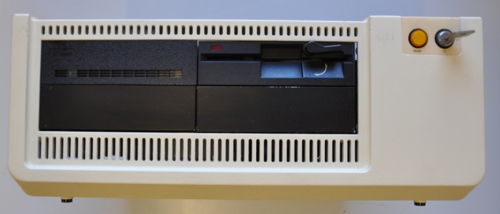
122 2016:
Another Sun 3/50, in the older casing (production date 1986).
The CPU board is 501-1162 which is the non-FPU board, but it did
come with FPU. It has 4MB RAM. It boots without errors, but
I haven't installed an OS.
123 2016:
A Motorola MC68000 Educational Computer. This is a single board
system around the 68000 CPU, sold as an educational device for
a low price in the early 1980's. It is the MEX68KECB. In 2020
I finally soldered a serial cable and built a power supply
(from an old PC power supply) to power the system. And it
worked! It has TUTOR v1.3 running. Remember to first apply -12V,
then +12V and finally +5V.
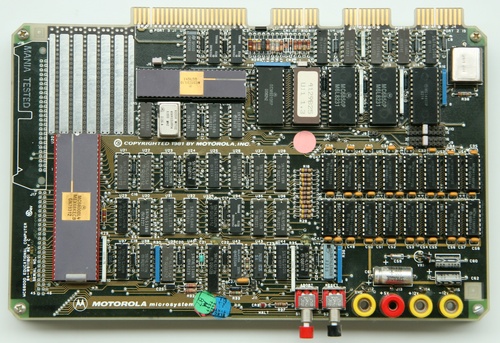
124 2016:
A SunBlade 2500. This one is beige. These were resold by Xerox
as print servers. Dual 1.28GHz CPU, 4GB RAM, 2x72GB disk, XVR-100
graphics. It runs Solaris 10. It wasn't until 2026 that I
turned the system on again. I put in a new battery. I found out
I don't have passwords, so I started a Solaris 10 install to
get a shell, mount the disk and fix the password/shadow files
to get access. It turns out one disk just has Solaris 10,
the other has the Xerox Freeflow Print Service running,
as well as TotalNET Advanced Server.
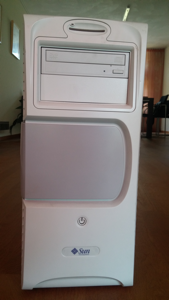
125 2017:
Another Sun IPC. I haven't played with it yet.
2017:
An SGI O2. It has an IP32 R5000 CPU, 256MB RAM and a 2GB
disk. It is running IRIX 6.5.18. When I got it, it would not boot,
but a quick reseating of the SIMMs and CPU fixed that.
In 2021, I started the system again and it worked. I then used
it to diagnose problems with another O2 to no avail. After that,
also this one won't boot anymore :(
In 2026, I was able to get one running again. The other has
a faulty CPU. I've sold both.
127 2017:
A Sun Ultra 60 with 1 360MHz CPU, 1GB of RAM and 2 Creator3D
video cards. When I booted it, it gave me a "RED State
Exception". I reseated the CPU and that helped. I also put
in an extra GB of RAM and swapped the 2 9GB drives with 2 72GB
drives. And I swapped one Creator3D with an Elite3D video card.
The NVRAM is empty but I fixed that. Now for the OS. FreeBSD 11.1
does not have binary packages for X on sparc64 and building X
(actually gcc5) failed. OpenBSD 6.2 installed just fine, but X
is not working properly (may be due to the monitor). Then I
came across Tribblix. That was easy to install (it now runs
m18) with a bit of help from Peter Tribble (I needed to
add the HME driver after installation to get network,
"zap install -s /path/to/cd/pkgs TRIBdrv-net-hme"). It has
ZFS support, but I am unable to run X :-(
I've upgraded to 2x450MHz CPU's (swap J3001 for this).
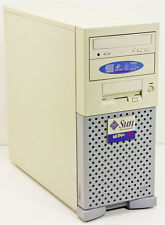
128-131 2017:
A bunch of Sun JavaStation-NC's, the 'Krups' model, all with
64MB RAM.
132 2017:
Another Sun JavaStation-1, the 'Mr. Coffee' model. It has 64MB
of RAM.
133-134 2017:
2 SunRay 3 thin clients, unfortunately, without power supply.
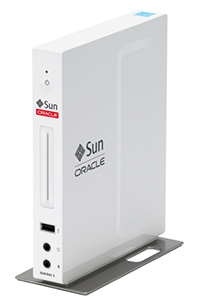
135 2018:
2 Sun V40z systems. I traded one of them. The other has 4 dual
Opteron CPUs, 16GB RAM, 5 72GB disks, a quad ethernet and 2
FC cards and is running FreeBSD 11.1. In 2026, it would not
boot. I installed FreeBSD 15.1 and set up RAID on ZFS while I
was at it.
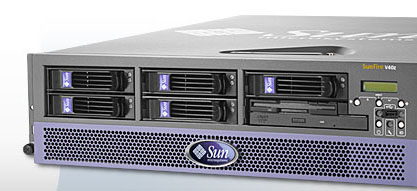
2018:
Another Sun SunFire V100 system. I took out the RAM to upgrade the
V100 I already had.
136 2018:
Another 4 Sun V20z systems, with one StorEdge 6130 disk array.
I kept one with 2 2.2GHz CPUs. I put in 2 146GB disks, 11GB of RAM,
DVD and 2 fiber channel cards. I've installed FreeBSD 11.1. The
others were all traded. Since I was not able to setup the disk
array, I re-installed Solaris 11 11/11. It says "Oracle
Corporation SunOS 5.11", shudder. It took me quite some
time to get the FC array to work, but all this FC stuff is new
to me. In the end, I just made one big pool with all the disks
(1.9TB) and I succesfully mounted it on a single mount point.
For fun, I weighed the disk array. It weighs 42 kilograms.
I also weighed an external 2.5" external USB drive of 2TB.
That weighed 257 grams. So 163 times less..
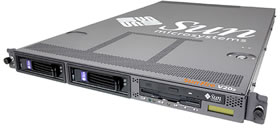
137 2018:
A Sun SPARCstation 20. I already had a SPARCserver 20, now I also
have the SPARCstation 20. It came with a 2GB disk, SM71 CPU (75MHz)
and a serial card (pretty rare). The NVRAM is empty but I've left
it that way. I've put in 512MB of RAM (there was no RAM in it)
and a CDROM player. After hacking the root password, I found a
working Solaris 2.6 installation.
138 2018:
A Sun SPARCserver 10. I already had a SPARCstation 10, now I also
have the SPARCserver 10. It had 64MB RAM and a 1GB disk with
Solaris 2.5.1. I put in a 2nd CPU, doubled the RAM and added
a 4GB drive. I reset the root password and kept Solaris 2.5.1.
The NVRAM is also empty.
139 2018:
An Apple Macintosh II. The PSU did nothing, but it was not the
fuses. After a bit of googling (computer repair is SO much
simpler than in the old days) it turned out to be the batteries
soldered on the main board. One supplies +3V to the PSU and if
that is missing, is does nothing. With an external 3V supply,
I got the system to boot. The drive had stiction. A firm turn
of the drive got it to spin and it booted MacOS! It has stuff
like PowerPoint 2.0 installed. I'm thinking about installing
A/UX, as it has the necessary FPU and PMMU chips. It has
5MB RAM, a video card, network card, 40MB hard drive running
MacOS 6.0.5 and a 800K drive. The floppy drive does not work well.
When I use the keyboard, the system hangs. It also does not
have a CD-ROM player, so installing A/UX might prove to be
quite the operation.
In 2026, the monitor broke. I replaced the 470uF 400V cap
and that got it going again. I thought the system was dead
but then I read what I wrote here and with a little spike
it booted up again. I see I've replaced the caps and the
batteries in 2018. After a while, the monitor lost its
vsync unfortunately.
140 2018:
An Apple Macbook Air 13" (A1369, late 2010 model). With 128GB SSD,
2GB RAM, 1.8GHz Core 2 Duo CPU. It runs macOS 10.13.5. I bought
this specifically to use to do my presentations with at
conferences.
2018:
A Motorola Delta model 8640 MVME188 system, rebadged by Digital,
but apparantly sold by Philips as a P9070r.
The case contains the 2P128CPU
(dual 88100 with 8 CMMU's), 128MB RAM
(2x MVME288), 2 MVME332XT boards for 16 serial I/O ports,
an MVME333-2 (serial controller), MVME374-1 (ethernet)
and an MVME328-2 SCSI controller with 3 Seagate 1GB(!) disks,
Exabyte 8200 8mm tape drive, and a QIC drive. Fully loaded
you might say!
It did not boot, because the timekeeper NVRAM was empty. I
soldered on a new battery.
With information I got (thanks Matti!) I could put the correct
values in the NVRAM and load the kernel. The harddisk contains
Motorola Multiprocessor UNIX System V/88 Release R32V3
M88100 Version 961030, but the kernel at first would hang
immedately after loading. It took a while to get it to boot to
a prompt. In fact, I'm not sure why it suddenly works again.
You can look at the settings
and a login session. It looks
like it was shut down more than 20 years ago and now it
still all works!
I gave it away in 2023. It is now in Switzerland.
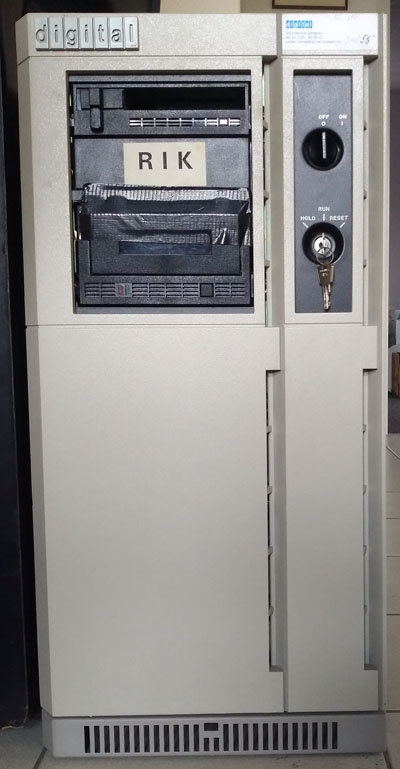
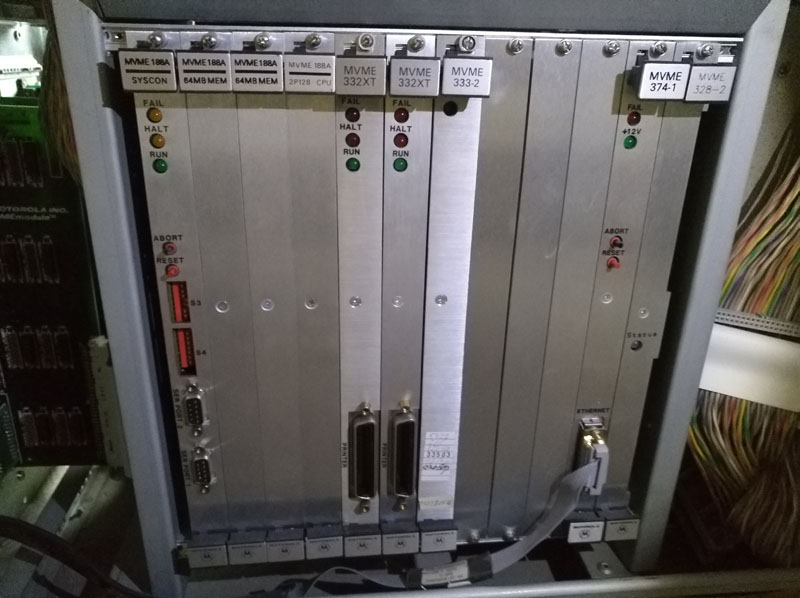
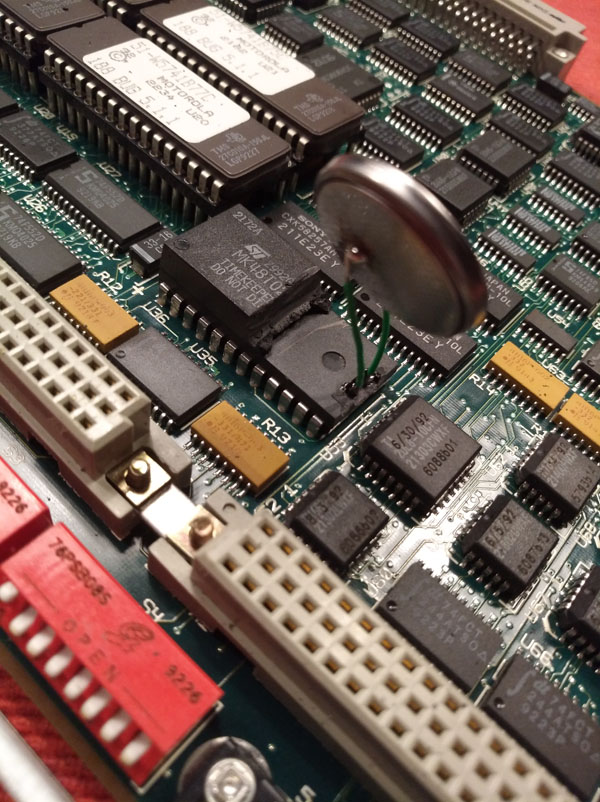
141 2018:
An Apple IIc with joystick and monitor. The monitor died after
a few minutes in a puff of smoke, have to look into that. The
system works fine otherwise.
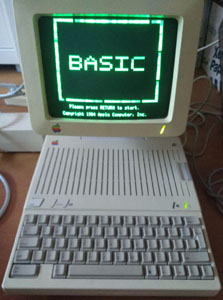
142 2018:
Another Sun SPARCstation Voyager. It has 80MB RAM, an 810MB
drive and a cgsix framebuffer! It also includes a battery,
keyboard, mouse and carrying case. It was running Solaris 2.6
when I got it. I installed a fresh Solaris 2.6 on it.
I fixed the NVRAM by soldering on a new battery. When I put
the LCD screen on my other Voyager to pinpoint a problem, it
seems to have been fried :-(
143 2018:
Another Sun Ultra 5. 360MHz CPU, 256MB RAM, 8.6GB disk, CDROM,
floppy and a Penguin card (SunPCi 400Mhz). It's running
Solaris 9 and the NVRAM is empty.
144+145 2018:
2 SunRay 2's (single head).
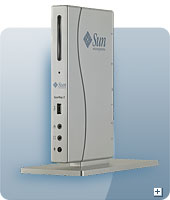
146+147 2018:
Three Sun 3/50's. One with 4MB Solflower expansion, with the monitor
dimple. One standard 4MB model without the dimple. And one
with a Solflower expansion, that fails the self-test (hangs
during "Segment Map Wr/Rd Test").
148 2018:
A Sun 3/75. I was looking for a 3/75 for about 20 years.
Finally found one.. but without a CPU board. Then somehow I found
somebody with a CPU board (the 'Carrera' or '3004') in the USA.
That was shipped to me. Who would have thought these could still
be found! After starting up the system, a cap blew. I bought
a surplus variac from my employer to prevent this happening with
other systems in the future. The CPU has 4MB on-board.
Later investigation revealed the 120/240V switch was defective
so the PSU was running at the wrong setting and it blew more than
just the one cap. I took the PSU out of a defective 3/50 and
got this thing to work again. I've tried adding a SCSI board
but the 3/75 is really picky and wants a 501-1045 which I don't
have (the 501-1217 and 501-1236 are not supported). I've put in
a 4MB RAM board (501-1132) instead.
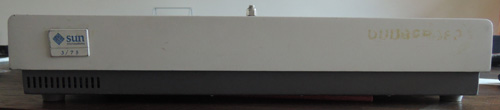
149 2018:
A Sun 2/120. 4MB RAM, SCSI, Ethernet, SMD controller and QIC-11
drive. I've removed the SMD controller and put in an extra MB
of RAM. It netbooted SunOS 4.0.3 from ie(), but I wanted
to put a SCSI harddisk in it. While doing some experiments, I
fried the Sun ethernet card :-( I replaced it with a 3Com card.
I got a Micropolis harddisk that is recognised but the system
doesn't want to netboot from ec(). It turns out the 3Com card
can only buffer 2 packets. NFS requests ask for 8KB normally,
which is split in 6 fragmets. Only two get buffered and if not
read fast enough, the other 4 are dropped. Then, a retransmission
is requested for the whole 8KB, resulting in an infinite loop.
I then found in my stack of VME boards one that contained a Sun
mbus Ethernet card. With ie(), it netboots again. I've copied
all data to the hard disk, but it now fails on building the boot
blocks (only later I found out, by looking at the source, that it
is just a matter of dd-ing a few bytes to the beginning of the disk).
But I took an alternative route, I used tme to emulate a Sun2 and
installed SunOS 3.2 on a virtual disk I prepared to be of the
correct size, then copied that byte-by-byte to a physical one.
It now boots SunOS 3.2 (full install) from disk! Thanks to the help
from
tme,
HeelToe
and Bear.
I later put some work into installing SunOS releases on virtual
disks using the same techniques and in the end I was able to get
working disks with SunOS 1.1, 2.0, 3.2 and 4.0.3. You can view
detailed instructions on a
separate page.
I then took the DES encryption chip I got 10 years ago from Per
out of my 3/60 and put it in the 2/120. With SunOS 2.2, I was able
to use it with the des(1) command. Encrypting the kernel takes
12 seconds with the chip, 4 minutes and 15 seconds without.
See also this
YouTube movie about the Sun 2/120 and
this movie about the
DES chip.
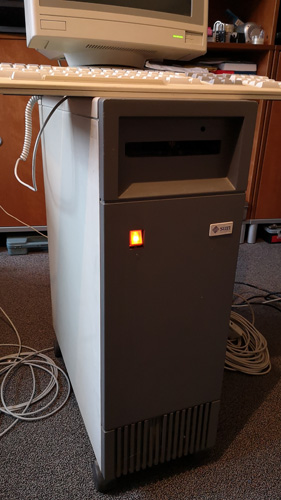
150-154 2018:
A Sun 3/50 with dimple and 4MB Solflower expansion (8MB total).
A Sun 3/50 without dimple with a 3/60 motherboard with MG4 framebuffer
and 8MB.
An empty Sun 3/50 enclosure.
A Sun 3/50 without dimple and 4MB Solflower expansion (8MB total).
A Sun 3/60 with 12MB (no framebuffer). The big capacitor in the PSU
blew.
Another Sun 3/60 with 12MB (no framebuffer).
I gave 2 3/50's to the Océ museum in Venlo.
155 2019:
A SunFire T1000 with 8GB memory, 500GB disk, running Solaris 10.
I had to hack the root password and reset the ALOM password.
I wanted to install a clean Solaris 10 or 11, as the installed
version seems to be missing stuff (such as sshd). I took an
existing Solaris 10 box to turn into a JumpStart server,
but I gave up. I was not able to boot into a Solaris 11
installation. At some point, I did have a sun4v version of
Solaris 10 ready, but the server would not reply to the
requests from the T1000, even if the DHCP server was running.
I was not able to find the cause and just kept Solaris 10
(with in.telnetd).
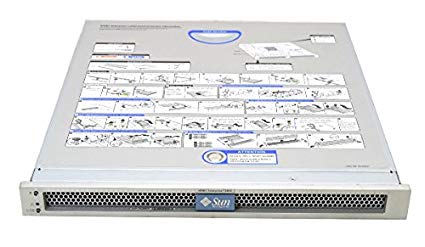
156 2019:
A Sun SunFire X2200. This is a dual 2.6GHz Opteron 1U system.
It has 2 250GB drives and 12GB memory. There was no OS on
it when I got it and I installed Solaris 11.4 (from USB stick,
the first time I've installed SunOS from something other than
floppy, QIC tape, CD-ROM, DVD or the network). After the
install, I wanted to setup DHCP and include the second disk
in the zpool, but Solaris 11 is so different that I just
switched to FreeBSD (after not being able to get OmniOS nor
OpenIndiana nor SmartOS to install/run).
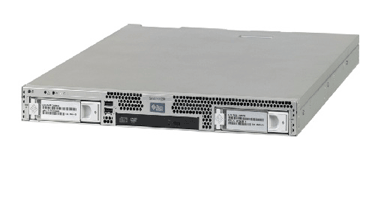
157 2019:
Sun 4/110. It has 8MB RAM on-board (from 32 SIMMs!) and a CG4
framebuffer. There is an FPU on the motherboard. It looks like
you can't add a memory board. I hooked up my SCSI2SD with a
Solaris 2.4 install CD on id 6 and a disk on id 0 and with
b sd(0,30,1) I could start the install, but it
would not install as it would not accept the network settings, or,
if no networking was chosen, the hostname (which was valid).
SunOS 4.1.4 did not want to install on a SUN9.0G disk, so I
chose a SUN2.1GB disk, which worked. I also looked through my box
o' simms to find 16x 1MB with parity, to upgrade to 20MB total
(mental note: don't forget to change the jumpers). Solaris 2.4
suddenly wanted to install, apparantly 8MB was not enough (but it did
not warn about this). NetBSD 8.0 would not install, I would
get a panic due to "stray interrupts cpu0".
In 2026, I tried the system again but the PSU is fried, it's
making clicking noises. Mental note: elco's: 1x 25V 470u, 1x 25V 220u,
4x 10V 1000u, 1x 50V 68u, 2x 6V "037", 4x 200V 1000u, ceramic
(2 unknown), 1x 100V 0.68u, 1x 100V 0.022u, 1x 400V 0.1u,
1x 400V 0.15u, 1x 250V 0.1u, 1x 400V 0.22u, 1x 250V 0.33u X2 MKT,
1x 250V 0.68u X2 MKT, "square ceramic": 2x 4700pF, 2x 2200pF,
1x 1000pF.
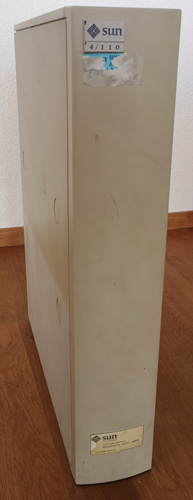
158 2019:
Another Sun 2/120! This one has a screen and keyboard. There are
no disks in it, it used SMD disks that are not there anymore.
Boards included are CPU, 4x1MB RAM, 3Com ethernet, SCSI controller,
monochrome framebuffer and SMD controller. It also has a QIC-11
tape drive. The PSU was dead and I could not find anything
obviously wrong with it. But: I found a NOS PSU (incredible
these are still around - thanks Geert!). The new PSU works
but the monitor does not. I hooked up another old monitor and
the system booted up from my SCSI2SD card. Have to look into
fixing the monitor but I've never done such a thing before.
The other monitor I have has the same part number, but is from
another supplier. The broken one is from Moniterm Corporation
(apparantly this must be a VR1000L20 and the
patent
is available on the net). The working one is from Philips.
2019:
An iRex iLiad 2nd Edition. This thing runs Linux under the hood,
will have to look into this further. When I got my hands on it
again in 2026, the softeners had come out of the plastic to such
an extent that I decided to throw it awat.
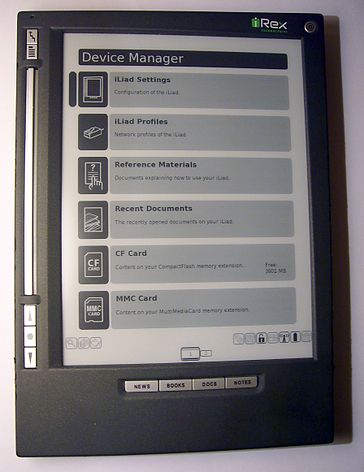
159 2019:
An enToruage eDGe 2.0. This is a combination of an ereader
and a tablet running Android 1.6. I could enable debug mode
by entering 89985b36B7906bFfF as password, but I can't seem
to connect via adb. Otherwise, I could root it and go from there.
160 2019:
I decided to by a new MacBook Pro (A1990) after all. Even if there's
no physical ESC key on it. It has a 2.4GHz 8-core CPU, 32GB of RAM
(double of what I had previously), 1TB SSD. It runs macOS
Mojave (10.14) (later upgraded to 10.15) and I don't
really want to upgrade any further
as Stuff Breaks. I can't even run my old screen savers any more.
But this touch bar is really what is very bad design on this
laptop. I though Apple understood ergonomics, but the touchbar
interferes in almost anything you do where you don't want it to
interfere, and the ESC key has no tactile feedback which is
really, really annyoing. The touch bar can be tweaked a bit, so
the worst things to accidentally touch can be moved aside a bit,
but still. Also I am having problems with a loose connector or so,
sometimes the sounds will be non-functional. But a reboot fixes it,
so maybe it's software after all. I should have waited for the
newer MacBook where they figured out the touchbar is evil.
In 2023, I finally upgraded to MacOS 14.2 (Sonoma) and later 15.4
(Sequioa) as it became
too much of a problem running so much behind. I spent a week
on getting everything to work again, had to pay again for a number
of licences, had to switch screensaver again, and had to
install a VM with an older MacOS to keep running some of the
old programs I had. The biggest issue was iPhoto now truly
being gone. I migrated to Photos but getting the album information
over took many attempts and almost a week.
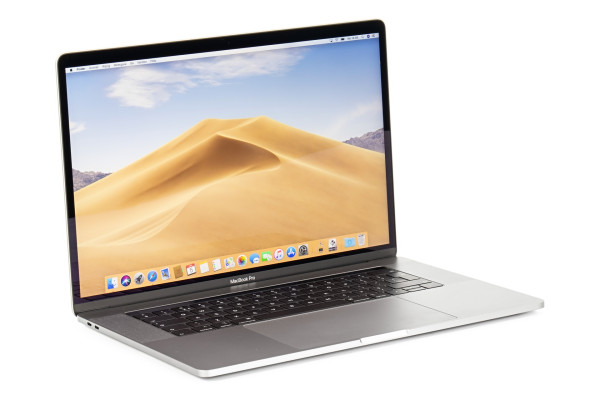
161 2020:
Another SunBlade 100 (1GB RAM, 2 20GB disks). The NVRAM was empty but
that did not prevent it from booting (you just need to manually
set an ethernet address once booted). The system had Solaris 8 on
it. It was nl1dahd2.gesm.ao-srv.com. Since there was still a bit
of data on there, I re-installed it (with FreeBSD 11.1) and
securely erased the disks in the process.
162 2020:
Another Sun SparcStation 10. 75Mhz processor, 128MB RAM, 1 2GB and
1 426MB drive, cgthree framebuffer. The NVRAM is empty. I had to
reseat the SIMMs. It had Solaris 8 on the 2GB drive and a
426MB drive labeled SunOS 4.1.3, but it would not boot from the
SunOS drive. Inspection after booting from my SCSI2SD drive (I
needed to set the hostid in NVRAM to let it boot) showed
that this disk was actually empty. The 2GB disk had (unrepairable
hardware) media errors. I installed SunOS 4.1.4 on the 426MB
drive (actually I copied over a disk and built new bootblocks).
163 2020:
Another Sun SparcStation 20. It has 2 SuperSPARCII processors at
75MHz, 384MB memory, a 2GB disk, floppy and CDROM. It must have
had some networking function, as there are 2 additional ethernet/SCSI
cards and a token ring card in it. I temporarily
put in a VSIMM and tried to boot. The kernel (Solaris 2.5.1)
would immediately give a BAD TRAP. First I suspected the RAM,
but the system booted fine from CD-ROM. I could then also access
the disk and fsck it but it would not boot afterwards from that disk.
A corrupted disk? I wanted to install a second disk, but in my
huge pile of disks, I only found one single height WC disk and that
would no longer work. So I reinstalled an OS. I chose NetBSD 8.0
which I found I had burned a CD of earlier. (All my Solaris media
is not easily accessible at the moment.) This worked fine on the
original disk.
164 2021:
Another Sun JavaStation-NC, the 'Krups' model
165 2021:
An RDI PrecisionBook model H18-12-2X-512L2. It's a 180MHz HP-PA
system with 512MB RAM and 2 4GB harddrives (IDE with a SCSI-to-IDE
converter). This particular system was used to port OpenBSD to
the PA-RISC architecture. It sort of boots OpenBSD, then fails on
finding init. There's no connectors to hook up any (CD)
drive, so I need a network boot server (the docking port
has some weird proprietary connector). It turns out this thing
uses bootp/tftp so that shoule be easily set up. However, my
FreeBSD tftp server did not grok the requests for partial files
from the RDI (Unknown option: '^B
The OpenBSD took its time, about 6 hours to verify the data
sets, another 6 to install them. After installation of OpenBSD 6.9,
I was once again greeted with a /dev/console not found
error. But then, after a few reboots, it did suddenly work...
This is really black magic. When I tried starting X, the screen
froze, although X was running. No output on VGA. I found out
that I had, in the BIOS, change the screen by typing mo
GRAPHICS(0) 1. The LCD is then shut down and everything goes
to VGA. X then works. I need to do a mo GRAPHICS(0) 5
to get back to the RDILCD panel.
2021:
An SGI Indy! I had 5 before, but got rid of all of them. Now I
have one again! It's an R4600 with 64MB RAM and a 4GB hard drive.
I did not have any passwords, so I used another system to
change the password hashes and then I could log in to find
IRIX 6.5.2 running. The system does not seem to recognise its
ethernet card, probably due to an empty NVRAM. I love to hear
the typical Indy-sounds again!
In 2026, I fixed the NVRAM, reprogrammed the ethernet address
and sold the system.
2021:
Another SGI O2. The configuration is unknown yet, other than it
has a 9GB drive. It appears to be dead. I've tried to use my other
O2 to find out what is wrong. After swapping RAM around, neither
wants to boot any more :-( I fixed that in 2026 and sold it.
168 2021:
Another Sun SparcStation 5. 176MB RAM, 9GB drive, cg6, running
OpenBSD 3.6.
169 2021:
Another Sun SparcStation 5. It has 192MB of RAM, a 4GB drive
which I could not boot from. Rummaging through my CD's I found
a NetBSD 8.0/sparc install CD and used that to get the system
up and running.
170 2021:
Another SunBlade 150. It has 128MB RAM and a 40GB drive, running
Debian Linux. The NVRAM is empty. I don't know how to boot in
single user mode and have no plans on learning Debian.
I found a FreeBSD 11.1 CD and installed that instead.
Reprogramming the NVRAM turned out difficult. The instructions
at https://github.com/MrSparc/idprom-repair/
did not work. I then found this site
and with these instructions it did work.
171 2021:
Another Sun Netra T1 model 105, with 440MHz CPU, 1GB RAM and
2 72GB drives. It has a PROM password set, which I need to hack
around. First I tried putting in the disk from my other Netra T1,
so I can become root and reset the firmware password. But, the
system needed the password to boot from anyting other than the
network. I then found that JP13 would reset the password. However, I could not find this jumper, not even with the service
documentation. I noticed a small DIP8 chip with a Sun-label and
took it out, it turned out to be an Intel EPC1213PC8 ROM. My
programmers were unable to read it. The system does not boot without
it and hot swapping it didn't work.
I decided to put the network card and CDROM player
into my other Netra T1, swap the drives (this one now has 2x 18GB)
and use this one for spares.
172 2021:
A Lenovo Tab 10 (TB-X103F) tablet. It was running Android 6.0.1
and the latest available update was from 2018 (still 6.0.1).
I put LineageOS 14 on it (Android 7.1 with fairly recent
patches).
173 2022:
A Qotom system as a replacement home server. Finally there is
a bit of choice in low-power systems, but if you want at least
3 ethernet ports, there's not much to choose from. I went for
the Q575G6 which has an Intel Core i7 at 2.7GHz, 6 Gbps ethernet
ports, and a serial port. I've put in a 1TB M2 SDD drive and
16GB of RAM. It ran FreeBSD 13.0, 13.1, 13.2, 14.0, 14.1, 14.2,
14.3, 14.4, 15.0
and is
now running FreeBSD 15.1. Fun fact: the Secure Boot platform
key has the text "DO NOT TRUST - AMI Test PK" in it.
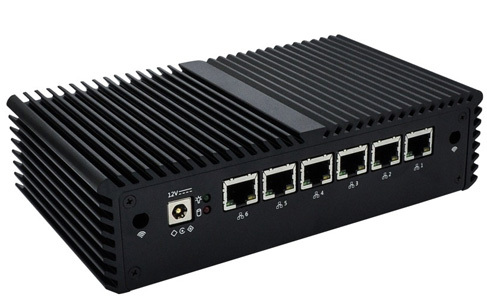
174 2022:
My wife's old DELL XPS 13 9350 laptop (512GB SSD, 8GB RAM, Intel
i7-5500U at 2.4GHz). It runs Windows 10 at the moment.
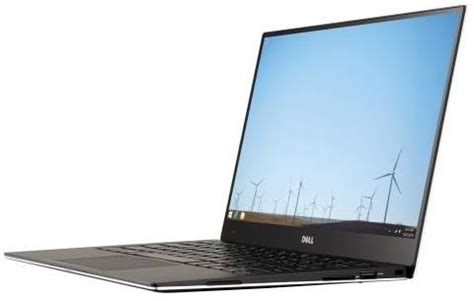
175 2023:
Another Sun JavaStation-NC, the 'Krups' model. With 32MB RAM.
With original manual and even a Sun-branded ethernet cable!
176+177 2024:
Another 2 SunRay 2's (single head). This time, in the original
box, they look unused..
178 2024:
A Lenovo IdeaCentre AIO 910. This is an all-in-one system with
an Intel i7 at 2.8GHz, 16GB RAM, GTX 950A video and 258GB SSD
storage. It has a 27" UHD touchscreen and came with Windows
10 Home.
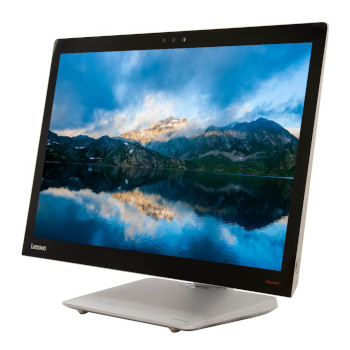
2024:
An Epson L3s laptop. It's a 80386-16 with 40MB harddisk. I made the
beginners mistake of trying to powering it on when I got it. The
power LED went on and that was it. I got distracted and had the
laptop connected (although turned off) and a while later something
had almost melted through the bottom. After opening it up, it was
clear that a few caps in the PSU had died, and the melting was
from a huge Epson E01161NA chip that had actually cracked. I think,
for me, this is beyond repair sadly.


179 2024:
A Palm Tungsten T3.

180 2024:
An HP 1U server. It's a DL360 (10th gen) with dual Intel
Xeon Silver 4116 (12 core) at 2.1GHz and 128GB memory. It replaces
my HP DL120 server as that was already 9 years old (still going
strong though!). It's now running FreeBSD 14.4. The page you're
looking at is coming from this server :-) In 2025, I increased
memory to 256GB.

181 2024:
A SunBlade 2500 Red. Single 1.28GHz CPU, 2GB RAM, no disks,
XVR-100 graphics. I put in 2 36GB drives I had lying around and
installed OpenBSD 7.6 on it via the Plexwriter CDRW, that
wouldn't really open and needed some persuasion. Now I have three
variants of the Blade 2500: red, silver and beige.

182 2024:
Another Sun Ultra 10. This one is special, as it was the main
build server for Blender. I believe it was originally acquired
by Not a Number. It has a 300MHz CPU, 640MB of RAM, a 4GB IDE disk,
a DDS tape drive and an Elite3D-m3 video card, running Solaris 8.
I had to fix the NVRAM battery. More info later.
183 2025:
A new MacBook (model A3112) to replace my previous one from 2019.
It's my 7th and after the transition from PowerPC to x64 and from
32bit to 64bit, I now make the switch to the M4 processor.
It's a silver 14" MacBook Pro, with M4 10C-CPU/10C-GPU processor,
32GB RAM and 2TB SSD. The screen is a bit smaller, but the big plus
is that I finally got rid of that awful touchbar. The guy in the
store said he had had a Mac with touchbar that broke four times(!)
It's running MacOS 15.

184 2025:
Another Sun SparcStation 5. It has 144MB of RAM, floppy and
2 drives (1GB and 2GB) that both turned out to be dead. What is
surprising, is that the NVRAM still contains data (MAC
08:0:20:76:58:e7). I removed the failty drive and installed
the first thing I could find, OpenBSD, on the 1GB drive (that I
wiped first).
185 2025:
Another Sun Ultra 10. With 333MHz Ultra-SPARC-IIi CPU,
256MB RAM and 2 drives, of which one 9GB was dead, and the
other is not recognised. The NVRAM is empty..
????:
A Philips VG8235/20 MSX2. I shelved it while it was working,
but somehow forgot to add it to this page when I got it. In 2025,
I went to the MSX2GOTO40 event (40 years of MSX2) and my
enthusiasm was sparked again. I bought an MSX PICO module. When
I tried to start up the MSX, it was dead. At first it seemd to be
the 7912 voltage regulator, which I replaced. That didn't solve
the problem though. Instead of taking out the oscilloscope and
spend lots of time, I bought another MSX2.
186 2025:
A Philips NMS8250 MSX2. Finally I can play the old Konami games
again and with the PICO cartridge I also have SCC music.
187 2025:
A Dauphin DTR-1. It's a 80486 in portable format. Unfortunately,
I do not have the original keyboard, mouse, pen, or PSU. But
it does work and boots Microsoft Windows 3.1 for Pendrive.
I bought this system specifically for the HP Kittyhawk drive
(40MB), which is a 1.3" drive. I also have a lot of other disk
form factors, including 2.5", 1.8" and 1.0".
I even have the 0.85" drive that was used in the Nokia N91.
The system has 6MB RAM and runs at 25MHz.

188 2025:
Again, a Philips P2000C computer. I had one before between 1998-2005.
The P2000C is a transportable Z80 system from 1983, based
on the P2000, with 2 5.25" drives (TEAC FD-55F, so it
must be the P2012 model) and a built-in 9" screen. It has
64KB RAM and runs CP/M. But, it also has the rare CoWorker board,
which adds an 8080 CPU and the ability to run MS-DOS. After a
visual inspection of the PSU, I powered the system up succesfully,
but after 5 minutes, a RIFA cap blew with a puff of white smoke.
After putting in new caps, the system works, although drive 0
does not spin up. I disconnected it and made the other drive
the first drive. Anyone got a spare FD-55F?
Another issue is the the curled wire for the keyboard which
is disintegrating (typical for the P2000C). Otherwise, the system
still looks very good, it was dust-free inside, is not
discoloured, and comes with original floppies and a lot of
documentation, including the original service manual.
I could not easily get MS-DOS to work on the CoPower board,
but my guess is that it needs a hard disk. I have a RaSCSI
that should work on the SASI port on the P2000C, I had other
projects so did not pursue that.
Thanks Joost, Nico, Ben, Jim, Henk, Bart, Wouter, Paul, Ane-Pieter, SURFnet, Ton, Yves, Lino, Robert, Mark, Frits, Pitr, Stijn, Willem, Twan (DJO Venlo), Dimitri, CVML, Matti, Patrick, Andy, Eugene, Robert, Stephan, Rob, Wilko, Chris, Michiel, Egon, Henny, Remco, Wim, Huub, Joost, Paul, NLUUG, Edwin, Frans, Toon, Jaap, Diederik, UU, Bas, Marcel, Fred, Ad's neighbour, BCF TU/e, Victor, Erik, Alain, Xaa, Teus, Koef/Hans, Rudi, Jeroen, Bert, Paul, Rhodix UNIX Professionals, Klaas, Whitfield, Peter, C&CZ, Jan, Geert Jan, Christophe, Jan, Andreas/UNET, Bart, Hans, Alex&Wietze (RUG), Jan-Jaap, Marijke, Niek, Dennis, Hans and Bart (UU), Arno, Roland, Paul, Jan, Laurens, Martien, Antoine, Harm+Marc (TD Venlo), Rink, Geert/Tehuis voor Bejaarde Computers, Earl, Peter, Harrie, r3boot, Duco, Cees, Mustafa, Thice, Sjef and others!
Stuff I would like to have:
| Brand | Type | Remarks |
| Sun | 100(U) or 150(U) | I do seem to have a Sun1 CPU board |
| Sun | 501-1045 VME SCSI card | not another VME SCSI card |
| Sun | Ultra 80/3/45/25/24/27 | |
| Sun | SPARCstation ZX | |
| Sun | 486i | Unobtainium.. |
| Various | SunRay notebook | |
| Sun | JavaStation-E (Espresso) | |
| Sun | Java WorkStation (W[12]00z) | |
| Intergraph | Windows NT for SPARC | |
| Any interesting Sun machine |
I have for trade: Sun Ulta 5, Sun Ultra 10, IPC, JavaStation, Sun 3/50, Sun 3/60, Sparcstation 5, maybe more.
Not everything is listed. Obviously, I also have a lot of development systems like Arduino and Raspberry Pi, and a bunch of smartphones that are in fact Linux systems.

©1995-2026 Walter Belgers